
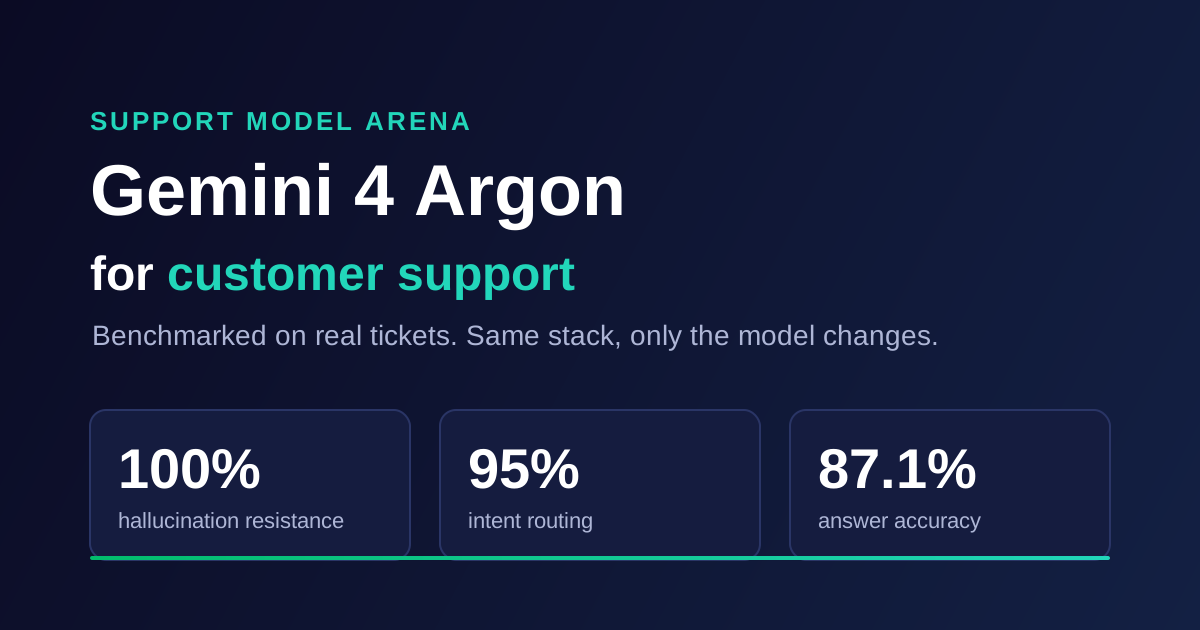
Gemini 4 Argon for Customer Support: Benchmark Results
IrisAgent now supports Gemini 4 Argon, Google's newest model, in two settings: low thinking and high thinking. We ran both through the same customer-support suites we use for every model on the Support Model Arena. The short verdict: Argon never invented an answer on a ticket it should have declined, and it routes intents well. But it also declines tickets it could have answered, its slowest responses are very slow, and at $2 / $10 per million tokens it trails every other model in its price class. We are not routing production traffic to it yet.
The short version
100% hallucination resistance in both settings: every should-decline ticket got a decline or handoff, never an invented answer.
95% intent routing, tied for 7th of 31 models.
87.1% answer accuracy in our recorded run, near the bottom of the board. Its misses were declines on tickets the knowledge base could answer.
A long latency tail. Its slowest responses took about 4x longer than Claude Sonnet 5.5's at the same price. The tail is what a live chat customer feels.
Overall 90.3%, last among the six models priced at about $2 / $10 per million tokens. Google's price rises to $4 / $20 on December 1, 2026.
How we tested
Every model on the arena runs inside the same production IrisAgent stack. Same retrieval, same tools, same prompts. Only the model changes. We grade five support jobs:
Answer accuracy: anonymized real support tickets whose answer exists in the knowledge base. A pass is a correct, grounded resolution.
Hallucination resistance: tickets that must not be answered from the knowledge base. A pass is a decline or handoff instead of an invented answer.
Cited sources: the same answerable tickets, but the answer must also cite the right knowledge base article.
Intent routing: multi-turn chats routed against configured FAQ intents and workflows, including near-miss intents and escalation requests.
Ticket tagging: exact-match classification against production tag catalogs from B2B customers.
The Overall score weights these 30% answer accuracy, 30% hallucination resistance, 15% cited sources, 15% intent routing and 10% tagging. The full method and every other model are on the Support Model Arena.
Results
Model | Overall | Answer accuracy | Hallucination resistance | Cited sources | Intent routing | Ticket tagging | Typical speed | Slowest responses | Price per 1M tokens (in / out) |
|---|---|---|---|---|---|---|---|---|---|
Gemini 4 Argon | 90.3% | 87.1% | 100% | 75.3% | 95.0% | 86.7% | Medium | Very long tail | $2 / $10 |
Gemini 4 Argon (high thinking) | 90.5% | 87.1% | 100% | 75.3% | 95.0% | 87.8% | Medium | Very long tail | $2 / $10 |
Gemini 3.8 Flash | 89.9% | 85.9% | 100% | 75.3% | 95.0% | 85.7% | Medium | Moderate tail | $0.75 / $3.75 |
Gemini 3.1 Pro (thinking) | 93.3% | 96.5% | 95.0% | 82.4% | 97.5% | 88.8% | Slower | Moderate tail | $2 / $12 |
Claude Sonnet 5.5 | 93.0% | 92.9% | 100% | 82.4% | 92.5% | 88.8% | Fast | Tight tail | $2 / $10 |
GPT-6 Sol | 92.2% | 100% | 90.0% | 77.6% | 97.5% | 89.8% | Fast | Tight tail | $2 / $10 |
Claude Opus 5.5 | 94.1% | 97.6% | 95.0% | 87.1% | 95.0% | 89.8% | Slower | Tight tail | $4 / $20 |
Single runs, exact-match grading. The decline suite is small, so a single ticket moves hallucination resistance by several points. Treat small gaps as ties. Speed labels compare the same production stack for every model. Argon's introductory price is $2 / $10 through November 30, 2026, then $4 / $20.
Where Gemini 4 Argon is strong
It does not make things up. Both settings declined or handed off on every ticket that the knowledge base could not answer. Several models in its price class, including GPT-6 Sol (90%), invented at least one answer on that suite. For a support bot that talks to customers unsupervised, this is the failure that matters most.
Intent routing. Argon passed 95% of routing checks in both settings, tied for 7th of 31 models. Its misses came down to one scenario: a configured workflow that should open by asking the customer to describe their issue. Argon either jumped to an agent handoff or skipped the workflow. Everything else, including near-identical intents and escalation requests, it routed correctly.
Clean tagging on structured catalogs. Argon tagged one of the production catalogs perfectly. About three in four of its tagging misses at low thinking left a ticket untagged rather than applying a wrong tag, which is the safer error when tags drive routing.
Where it falls short
It declines answerable tickets. In our recorded run Argon resolved 87.1% of answerable tickets, versus 92.9% for Claude Sonnet 5.5 and 100% for GPT-6 Sol at the same price. A second run on the same day scored 92.9%, so the true number likely sits between the two. In that run, every miss was the same kind of error: Argon said it could not answer when the right article had been retrieved. Restraint is good. Restraint on tickets you could have solved is a deflection you gave away.
Tail latency. Argon's typical response time is reasonable, about a third slower than Gemini 3.8 Flash. Its slowest 1% of responses is the problem: about 4x slower than Claude Sonnet 5.5 and roughly 9x slower than GPT-6 Sol, both at the same price, and about 2.5x slower than Gemini 3.8 Flash. In live chat, a long wait is an abandoned conversation.
Price for what you get. At $2 / $10, Argon scores below Claude Sonnet 5.5, Gemini 3.1 Pro, GPT-6 Sol and GPT-6.1 Sol. Against its own family, it edges Gemini 3.8 Flash on answer accuracy and ties it on every other quality score, at about 2.7x the price and with a slower tail. From December 1 the price doubles to $4 / $20, the same as Claude Opus 5.5.
High thinking is not an upgrade for support. Turning thinking up did not change answer accuracy, cited sources, hallucination resistance or intent routing. It nudged tagging up slightly, made typical responses a little slower, and thinking tokens are billed as output. For support work we would run Argon at low thinking.
How IrisAgent uses it
IrisAgent does not bet on one model. Our multi-LLM engine picks a model per task from this board, and customers can choose the model they prefer. Gemini 4 Argon is available today. On these results we are not replacing any production model with it: where we use Gemini today, Gemini 3.8 Flash delivers nearly the same quality faster and for less. We will rerun Argon as Google updates it, and we are testing it on task-specific work such as tool use before drawing conclusions there. Every answer, whichever model writes it, goes through IrisAgent's grounding checks before it reaches a customer.
For the wider picture of how today's models compare on support work, see Best LLMs for customer support chatbots and how we measure accuracy.
See the full board
The Support Model Arena ranks every model we support by category, with latency and price next to quality. If you want to see how these models perform on your own tickets, book a demo.
Loading the form. Prefer email? Reach us at info@irisagent.com or call +1 617 249 3312.