
First Call Resolution (FCR): Definition, Formula & Benchmarks
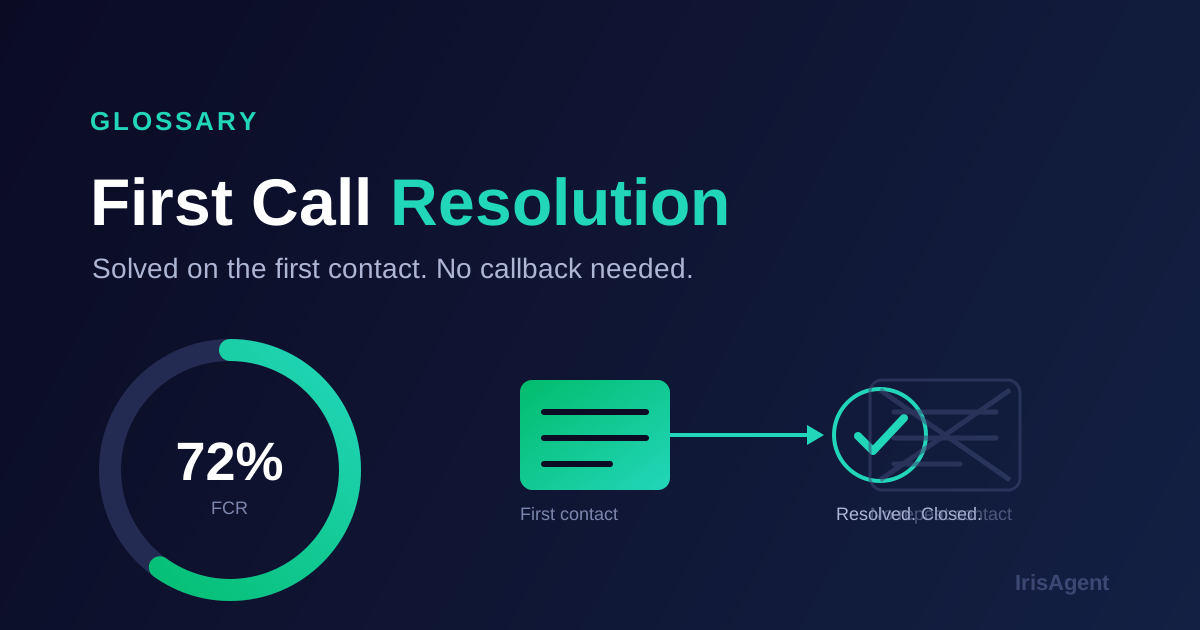
First call resolution (FCR) is the percentage of customer support interactions that get fully resolved during the first contact, with no callback, follow-up email, or repeat ticket required. It is one of the clearest signals of whether a support team is actually solving problems or just closing tickets.
IrisAgent resolves 50%+ of tickets end to end on the first interaction, without a human agent needing to follow up, by grounding every answer in the customer's own account data and support history. That single number is the difference between a support team that looks efficient on a dashboard and one that customers trust.
Most teams track FCR as a lagging indicator: a number that shows up in a weekly report, gets nodded at in a stand-up, and rarely changes anything. That is a mistake. FCR is one of the few metrics that connects directly to CSAT, agent workload, and support cost, all at once. This guide covers the formula, current benchmarks, what actually moves the number, and how AI changes the math.
What Is First Call Resolution?
First call resolution measures whether a customer's issue gets solved the first time they reach out, without needing to contact support again about the same problem. The name comes from call centers, but the metric applies to every channel: phone, chat, email, and in-app messaging.
Some teams use "first contact resolution" instead of "first call resolution" for exactly this reason. The math is identical. What counts is whether the customer's issue closed on the first interaction, not which channel carried it.
FCR is different from resolution rate, which measures whether a ticket eventually gets solved at all. FCR is stricter. A ticket that took three follow-up emails to close still counts as "resolved," but it does not count as a first call resolution.
The First Call Resolution Formula
The standard formula is straightforward:
Count first-contact resolutions. Tally every ticket, call, or chat that closed without the customer needing to reach out again about the same issue.
Count total contacts. Tally every support interaction in the same period, including the ones that needed a follow-up.
Divide and multiply by 100. FCR = (First-Contact Resolutions ÷ Total Contacts) × 100.
For example, if a support team closes 1,000 tickets in a month and 720 of those never generate a follow-up, the team's FCR is 72 percent (720 ÷ 1,000 × 100).
The hard part is not the math. It is defining "resolved." A ticket the agent marks closed but the customer reopens within 48 to 72 hours should count against FCR, not toward it. Most help desks (Zendesk, Salesforce Service Cloud, Freshdesk) let you configure a reopen window for exactly this reason. Set one before you start reporting the number, or the metric will flatter you. The same applies if you run a self-hosted open source help desk: confirm how it treats reopened tickets before you trust the number.
Why First Call Resolution Matters
FCR is one of the few support metrics that moves customer satisfaction and cost in the same direction at once. A customer who gets their answer on the first try is measurably happier, and the support team spends less total effort per issue.
Research from the Service Quality Measurement Group, the industry standard for FCR benchmarking, has repeatedly linked FCR to customer satisfaction more strongly than speed metrics like average handle time on their own. A fast answer that does not solve the problem still generates a callback, and the callback costs more than if the agent had gotten it right the first time.
That is the tension every support leader manages: speed and resolution pull against each other if a team is not careful. Pushing agents to close tickets faster, without giving them the context to solve the issue completely, drives handle time down and FCR down together. The fix is not choosing one metric over the other. It is giving agents (or an AI agent) the account context and knowledge grounding to solve the issue correctly on the first attempt, which improves both numbers at once.
Industry First Call Resolution Benchmarks
Industry research puts average FCR in the 70 to 74 percent range across support organizations, with the Service Quality Measurement Group citing 71 percent as a common cross-industry baseline. A 70 to 79 percent FCR is generally considered a solid, healthy rate.
Teams above 80 percent are rare. Industry data suggests only a small share of support organizations consistently clear that bar, and it typically requires strong knowledge management, tight agent context, and low ticket complexity.
FCR also varies by industry and channel:
Financial services and utilities tend to run higher, often in the 76 to 82 percent range, because issues are more procedural and better documented.
Telecom support tends to run lower, often 52 to 58 percent, because issues frequently require account-specific troubleshooting across multiple systems.
Chat and email typically show higher FCR than phone, since agents (or AI) have more time to look up account details before responding.
If your team's FCR sits well below 70 percent, that is not automatically a performance problem. It is a signal to check whether agents have the account context and knowledge base access they need before they respond.
Resolution rates are partly a culture question. Teams that have written down a customer service philosophy settle the speed-versus-resolution tradeoff in advance: agents know whether the rule is to close fast or to fix the root cause, so they stop guessing on every ticket.
7 Ways to Improve First Call Resolution
Give agents full account context before the first reply. The single biggest driver of repeat contacts is an agent who answers without seeing the customer's plan, billing status, or prior tickets. Agent assist tools that surface this automatically remove the guesswork.
Ground every answer in your actual knowledge base. Agents (and AI) that improvise from memory get details wrong. Answers pulled from verified help center articles and internal SOPs close the loop correctly the first time.
Route tickets to the right team on intent, not keyword. A misrouted ticket almost always generates a follow-up, because the first responder cannot fully solve it. Intent-based routing gets the issue to someone who can close it outright.
Fix the top 10 repeat-contact reasons first. Pull your reopen and follow-up data monthly and rank the most common root causes. A handful of issues usually account for the majority of repeat contacts, and those are the highest-leverage fixes.
Set a clear reopen window and measure against it. Without a defined window (48 to 72 hours is standard), teams cannot tell a genuine first-contact resolution from a ticket that bounced right back.
Coach on completeness, not just speed. If agents are scored primarily on handle time, they will optimize for it at FCR's expense. Balance the scorecard so agents are rewarded for solving the issue, not just closing the ticket.
Let AI handle the tickets it can fully resolve. Simple, well-documented issues (password resets, order status, plan changes) are ideal candidates for automated resolution, which removes the chance of a rushed or incomplete human answer entirely.
How FCR Relates to AHT and Ticket Deflection
FCR does not exist in isolation. It works alongside two other core support metrics:
Average handle time measures how long an interaction takes. Optimizing AHT without watching FCR is how teams end up with fast, incomplete answers and more repeat contacts. The two metrics should always be reviewed together, never in isolation, on the same support metrics dashboard.
Ticket deflection rate measures how many contacts get resolved through self-service before a human agent is ever involved. Deflection and FCR are complementary, not competing: a well-deflected ticket that the customer solves themselves counts as a resolved issue with zero repeat-contact risk, which is the best possible outcome for both metrics at once.
First call resolution covers the contact. Incidents add a longer clock. If your queue includes outages and degraded service, the 10-step AI runbook for cutting mean time to resolution shows what to automate first.
How AI Improves First Call Resolution
The reason AI moves FCR more than most process changes is that it removes the two biggest causes of repeat contact: missing context and incomplete answers. IrisAgent's AI support platform grounds every response in the customer's actual account data, ticket history, and knowledge base, so both the AI and the human agents behind it are working from the same complete picture.
For tickets the AI resolves directly, there is no handoff and no chance of a partial answer, which is why fully automated resolutions function as a first-contact resolution by design. For tickets that escalate to a human, the agent starts with a full case summary instead of piecing the context together from scratch, which is the same context problem that drives repeat contacts down when solved well.
Next Steps
First call resolution is one of the few support metrics worth reviewing every week, not just every quarter. Start by defining a clear reopen window, pull your top repeat-contact reasons for the last 30 days, and fix the highest-volume one first. Then check whether agents have the account context they need before they respond, since that single fix moves FCR more than almost anything else.
If your team is stuck well below the 70 percent benchmark, the fastest lever is usually context, not headcount. See how IrisAgent grounds every response in your account data and support history to close more issues on the first try.
See latest stats: Customer support statistics 2026.
Frequently Asked Questions
What is a good first call resolution rate?
A first call resolution rate between 70 and 79 percent is considered solid for most support organizations, based on industry benchmarking research. Rates above 80 percent are achievable but uncommon, and typically require strong knowledge management and low ticket complexity. What counts as "good" also depends on your industry and channel mix, so compare against similar organizations rather than a single universal number.
What is the difference between first call resolution and first contact resolution?
The two terms measure the same thing. "First call resolution" is the original term from phone-based call centers, while "first contact resolution" is the modern, channel-agnostic version that covers phone, chat, email, and in-app messaging. Most support teams today use the terms interchangeably.
How do you calculate first call resolution?
Divide the number of tickets, calls, or chats resolved on the first contact by the total number of contacts in the same period, then multiply by 100. For example, 720 first-contact resolutions out of 1,000 total contacts equals a 72 percent FCR. The key is defining a clear reopen window, typically 48 to 72 hours, so a ticket the customer reopens does not count as resolved.
Why is my first call resolution rate low?
Low FCR is almost always a context or knowledge problem, not an agent effort problem. Common causes include agents lacking full account history when they respond, outdated or incomplete knowledge base articles, tickets routed to the wrong team, and scorecards that reward speed over completeness. Start by pulling your top repeat-contact reasons for the last 30 days and fixing the most common one first.
Does improving first call resolution increase handle time?
Not necessarily, and the two metrics should be optimized together rather than traded off. Giving agents (or an AI agent) full account context up front often reduces handle time and increases FCR at the same time, because less of the interaction is spent gathering information the system already has. The risk only appears when speed is optimized in isolation, at the expense of giving agents what they need to solve the issue completely.

Loading the form. Prefer email? Reach us at info@irisagent.com or call +1 617 249 3312.