
How to Coach Your AI Support Agent: A Practical Playbook (2026)
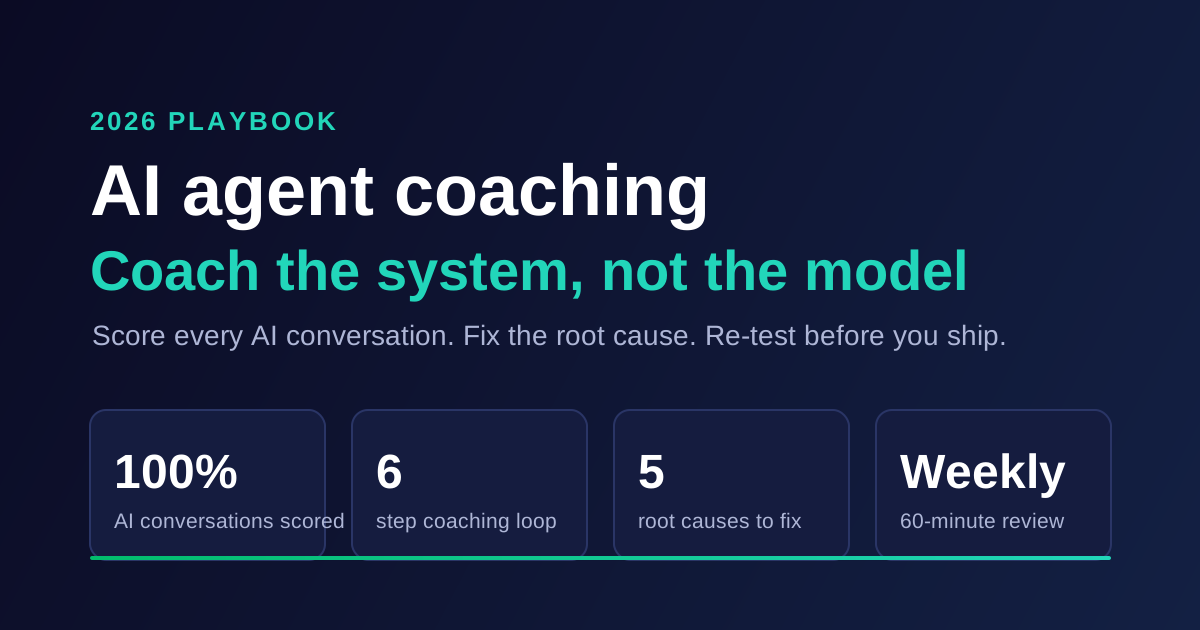
AI agent coaching is the ongoing practice of reviewing what your AI support agent says, finding the patterns where it fails, and fixing the root cause (its knowledge, its instructions, its guardrails, or its escalation rules) before re-testing and shipping the change. In practice, it is a weekly operating rhythm: score 100% of AI conversations, group the failures, fix one cause at a time, and measure whether resolution and accuracy actually improved.
Most support teams launch an AI agent, watch the resolution rate climb for a few weeks, and then stop touching it. The numbers plateau. A policy changes, a product ships, and the AI keeps answering from last quarter's article. Nobody notices until a customer escalates.
You already know how to fix this, because you do it with human reps every week. You set goals, keep a scorecard, review real conversations, and coach on specific behaviors. Your AI agent needs the same treatment, with one difference: you do not coach the model's personality. You coach the system around it.
This playbook gives you that system. You will get a side-by-side comparison of coaching a human versus coaching an AI agent, a six-step coaching loop, a scorecard template you can copy, a failure-pattern to fix table, a weekly and monthly cadence, the six metrics that matter, and a four-stage maturity model to see where your team stands today.
Key Takeaways
- Coaching an AI agent means fixing its inputs (knowledge, procedures, guardrails, escalation rules, integrations), not retraining the model. Every failure maps to one of those five root causes.
- Review 100% of AI conversations with automated QA. Sampling 2% to 5% of conversations hides the rare, high-cost failures like hallucinated refund policies.
- Never ship a fix without re-testing it against the conversations that failed. A fix that is not re-tested is a guess.
- Track deflection only with a CSAT guardrail. A rising deflection rate with falling CSAT means the AI is blocking customers, not helping them.
- Run a 60-minute weekly coaching review and a monthly scorecard review. Teams that stop reviewing after launch see accuracy drift as products and policies change.
Why Your AI Support Agent Needs Coaching After Launch
An AI support agent is only as good as three things: the knowledge it reads from, the guardrails that constrain it, and the feedback loop around it. The model itself is the least likely thing you will change.
That matters because the failure modes of AI agents are different from the failure modes of human reps. A new hire who does not know an answer usually says so and asks a teammate. An AI agent without a guardrail may answer confidently anyway. Gartner's customer research makes the stakes clear: in a 2024 survey of 5,728 customers, 64% said they would prefer companies did not use AI for customer service, and 42% named AI giving wrong answers as a top concern. Coaching is how you earn that trust back, one fixed failure pattern at a time.
There is also an internal cost. Gartner predicts that over 40% of agentic AI projects will be canceled by the end of 2027, citing escalating costs, unclear business value, and inadequate risk controls. An AI agent with no coaching rhythm is exactly the project that ends up on that list: nobody can prove what it is worth, and nobody can say what it is getting wrong.
Here is what that looks like in a real queue (an illustrative example, with fictional names).
Maya runs support operations at a fictional 400-person SaaS company. Their AI agent launched in March and hit a 38% resolution rate by April. In June, the product team moved annual-plan refunds from 30 days to 14 days. The help center article was updated, but an older internal PDF with the 30-day rule was still in the AI's knowledge sources. For five weeks, the AI quoted both windows depending on which source it retrieved. Maya only found out when a customer posted a screenshot on a community forum. The fix took 10 minutes: retire the PDF. Finding it took five weeks, because nobody was reviewing AI conversations.
Coaching a Human Rep vs Coaching an AI Agent
The coaching mindset transfers. The mechanics do not. Use this table to translate what your team already does for human reps into what works for AI.
Coaching element | Coaching a human rep | Coaching an AI agent |
|---|---|---|
What you are changing | Skills, habits, judgment | Knowledge sources, procedures, guardrails, escalation rules, integrations |
Evidence | A sample of 5 to 10 tickets per rep per week | Every AI conversation, scored automatically |
Feedback delivery | A 1:1 conversation | An edit to a KB article, a procedure, or a rule |
How fast it sticks | Weeks of repetition | Immediately, on every future conversation |
Consistency | Varies by mood, workload, tenure | Identical behavior for identical inputs |
Biggest risk | Burnout, inconsistency | Confident wrong answers at scale |
How you verify improvement | Next month's QA scores | Re-run the failed conversations before you ship |
Who owns it | Team lead or QA manager | Support ops or an AI operations owner, with QA input |
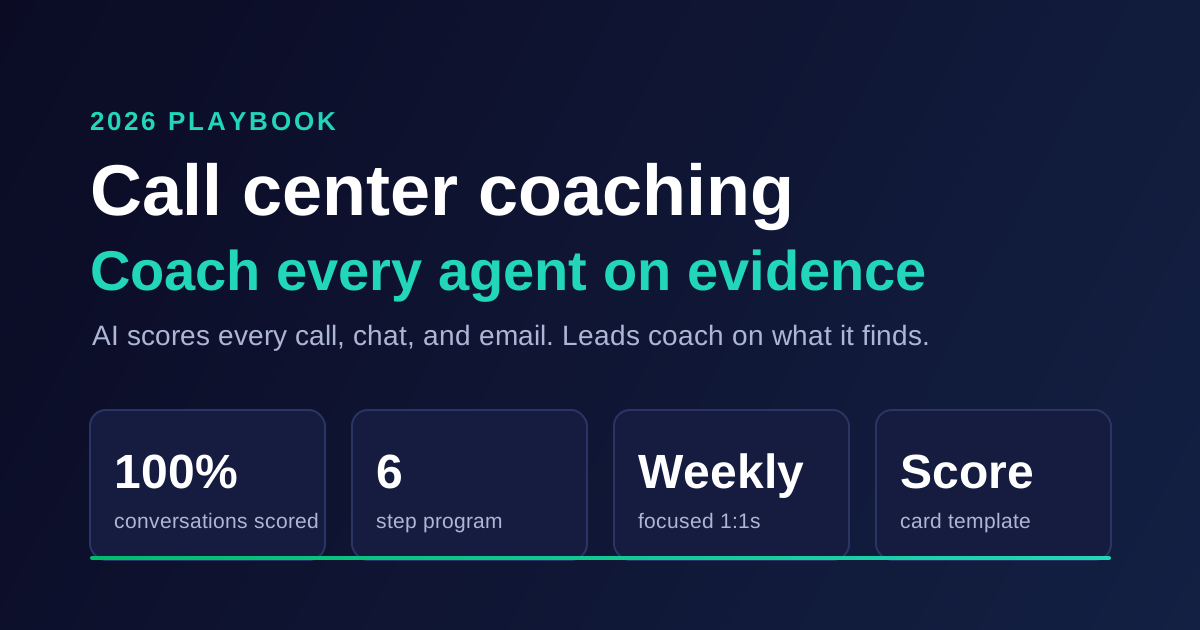
The key row is "what you are changing." When a human rep gives a wrong answer, you coach the rep. When an AI agent gives a wrong answer, you find the input that caused it. If you are building a coaching program for both, our guide to call center coaching with AI covers the human-agent side, and the two programs should share one scorecard.
The AI Agent Coaching Loop: Six Steps
This is the core of AI coaching for customer service after launch, and it picks up where initial AI agent training leaves off. Run it every week.
Step 1: Set Goals for the AI Agent
Write down what the AI agent is responsible for, in the same way you would write a job description. Name the intents it should resolve (password resets, billing questions, order status), the intents it must always hand off (legal threats, security incidents, high-value refunds), and the target numbers for each. A goal like "resolve 50% of tier-1 billing questions with CSAT at or above the human baseline" is coachable. "Make the bot better" is not.
Step 2: Review 100% of AI Conversations
Sampling works poorly for AI agents. The failures that hurt most (a hallucinated policy, a missed escalation on an angry enterprise customer) are rare, and a 3% sample will usually miss them. Automated QA scores every conversation against your rules, then surfaces the ones that failed. This is the same shift from sampling to full coverage that AutoQA brings to human QA, applied to AI.
Step 3: Group Failures Into Patterns
One bad conversation is an anecdote. Twenty bad conversations with the same cause is a coaching priority. Tag each failure with one of five patterns: wrong answer, hallucination, missed escalation, knowledge gap, or tone. Then rank the patterns by volume and by cost (a wrong answer on a refund costs more than a stiff greeting).
Step 4: Find the Root Cause
For each pattern, ask "what input made the AI do this?" The answer is almost always one of five things: the knowledge base, the procedure or instructions, a missing guardrail, an escalation rule, or a broken integration or action. The failure-pattern table later in this guide maps each pattern to its most likely cause.
Step 5: Fix One Cause at a Time
Change one thing per fix. If you rewrite the refund article, tighten the escalation rule, and adjust the tone instructions in the same week, you will not know which change moved the number. Small, isolated fixes make your coaching measurable.
Step 6: Re-Test Before You Ship
Take the conversations that failed and run them again against the fixed configuration. If the AI now answers correctly (and does not break any conversations that used to pass), ship it. If not, go back to step 4. This is the step most teams skip, and it is the difference between coaching and guessing.
Want to see what full-coverage review looks like on your own AI and human conversations? See how AutoQA scores every conversation.
The AI Agent Coaching Scorecard
A scorecard turns "the AI seems worse lately" into a number you can act on. Use this template as a starting point and write each criterion as a plain-English rule your QA tool can check. (For examples of how to phrase those rules, see how to write AutoQA rules in plain English.)
Criterion | What good looks like | How to measure |
|---|---|---|
Answer accuracy | The answer matches the current, approved source | % of conversations where the answer is supported by a cited KB article or procedure |
Grounding | No claims that are not in the source material | Hallucination rate: % of conversations with an unsupported claim |
Policy compliance | Follows refund, security, and data rules exactly | % of policy-relevant conversations with zero violations |
Escalation accuracy | Hands off when it should, and only when it should | % of escalations that were correct, plus % of conversations that should have escalated but did not |
Resolution | Customer's issue is solved without a human | Resolution rate, confirmed by no reopen within 7 days |
Clarity | Answer is direct, short, and step-by-step where needed | % of conversations passing a readability or structure rule |
Tone | Matches brand voice; acknowledges frustration | % passing tone rules; CSAT on AI conversations |
Handoff quality | Human agent gets full context and a summary | % of handoffs where the customer does not have to repeat themselves |
Weight the criteria by risk. For most teams, accuracy, grounding, and escalation accuracy should carry more weight than tone. A friendly wrong answer is still a wrong answer.
Failure Patterns and How to Fix Them
This is the table to keep open during your weekly review. Each failure pattern points to a likely root cause and a specific fix.
Failure pattern | What you see in the conversation | Most likely root cause | Fix |
|---|---|---|---|
Wrong answer | The AI answers confidently, but the answer is outdated or incorrect | Stale or conflicting knowledge source | Update or retire the source; set an owner and review date for the article |
Hallucination | The AI states a policy, price, or feature that does not exist in any source | Missing grounding check or a source gap the model "filled in" | Add a validation layer that blocks unsupported claims; add the missing article |
Missed escalation | The AI keeps answering when it should hand off (legal, security, VIP, repeated frustration) | Escalation rule is missing or too narrow | Add an explicit escalation rule for the intent or signal |
Unnecessary escalation | The AI hands off questions it could have resolved | Confidence threshold too strict, or a knowledge gap | Lower the threshold for that intent, or add the missing content |
Knowledge gap | The AI says it cannot help, or gives a vague non-answer | No article covers the question | Write the article, ideally drafted from resolved tickets on the same topic |
Procedure failure | The AI gives the right policy but skips a required step (verify identity, check eligibility) | Procedure is unclear or not written down | Rewrite the procedure as explicit, ordered steps |
Action failure | The AI says "your refund is processed" but nothing happened | Integration or API action failed silently | Fix the integration; require confirmation of the action result before replying |
Tone miss | Answer is correct but cold, robotic, or ignores the customer's frustration | Tone instructions are generic | Add specific tone rules (acknowledge the issue first, no blame language) |
Here is a second illustrative example. Daniel, a QA lead at a fictional ecommerce brand, noticed that 22 conversations in one week failed the "escalation accuracy" check. All 22 were customers asking about a chargeback. The AI was explaining the dispute process instead of handing off to the payments team, which was the policy. Daniel traced it to a procedure that said "explain dispute options" with no exception for active chargebacks. He added one line: "If the customer mentions a chargeback or bank dispute, escalate to Payments immediately." He re-ran the 22 conversations, all 22 escalated correctly, and he shipped the change the same afternoon.
Notice what Daniel did not do. He did not try to retrain a model or rewrite every prompt. He found the input that caused the pattern and changed one line.
A Weekly and Monthly Coaching Cadence
Consistency beats intensity. A 60-minute weekly review will do more for your AI agent than a two-day quarterly audit.
Weekly (60 minutes)
Review the scorecard (10 minutes). Look at this week's numbers against last week's. Flag any criterion that dropped.
Review the top three failure patterns (20 minutes). Read five to ten real conversations for each. Confirm the root cause.
Assign fixes (10 minutes). One owner and one due date per fix. Knowledge fixes go to the KB owner, procedure fixes to support ops, integration fixes to engineering.
Check last week's fixes (15 minutes). Did the re-tested fixes hold in production? Did the failure pattern volume drop?
Log it (5 minutes). Keep a simple change log: what changed, why, and what metric should move.
Monthly (90 minutes)
Review the trend on all six core metrics.
Compare AI conversation CSAT with human conversation CSAT on the same intents.
Decide which new intents the AI should take on, and which it should hand back.
Audit the knowledge base for articles with no owner or no review in 90 days.
Re-check escalation rules against any policy, pricing, or product changes from the month.
Quarterly
Revisit the AI's goals and the scorecard weights. As the AI matures, you will raise the bar on resolution and lower your tolerance for unnecessary escalations.
The Six Metrics That Tell You Coaching Is Working
You do not need a 40-metric dashboard. These six cover accuracy, outcomes, and customer experience.
Resolution rate. The percentage of AI conversations where the customer's issue was solved with no human involvement and no reopen within a set window (7 days is common). This is the headline outcome metric.
Deflection rate, with a CSAT guardrail. The percentage of contacts handled without reaching a human queue. Never report it alone. A rising deflection rate with falling CSAT means customers are giving up, not getting help. Our guide to AI deflection rate covers how to measure it honestly.
Escalation accuracy. Two numbers: the share of escalations that were correct, and the share of conversations that should have escalated but did not. The second number is the one that causes incidents.
Answer accuracy and hallucination rate. The share of answers supported by an approved source, and the share containing a claim that no source supports. Track hallucination rate as its own line, even when it is small.
Knowledge gap rate. The share of conversations where the AI could not answer because no content existed. This is your content team's to-do list.
CSAT on AI conversations. Measured separately from human conversations, and compared on the same intents. If AI CSAT on billing questions is 10 points below human CSAT on billing questions, that is a coaching target.
An AI Agent Coaching Maturity Model
Use this four-stage model to see where your team is today and what the next stage requires.
Stage | What it looks like | Evidence you have | Next move |
|---|---|---|---|
Stage 1: Launch and Hope | AI is live; someone reads a few transcripts when a complaint comes in | Anecdotes and escalations | Define goals and a scorecard |
Stage 2: Scheduled Spot-Checks | A weekly sample review; failures fixed ad hoc | A small sample, inconsistent tagging | Move to 100% automated scoring |
Stage 3: Closed-Loop Coaching | Every conversation scored; failures grouped by pattern; fixes re-tested before shipping | Full coverage, a change log, metric trends | Automate gap detection and content drafting |
Stage 4: Compounding Improvement | Knowledge gaps and policy drift are detected automatically; humans approve fixes instead of hunting for problems | Leading indicators, not just lagging ones | Expand the AI's scope to new intents with confidence |
If your team reviews a weekly sample of transcripts, you are at Stage 2. The jump that matters most is from Stage 2 to Stage 3, because that is when coaching stops depending on whether someone had time to read transcripts this week.
A third illustrative example. Asha leads support at a fictional fintech company that sat at Stage 2 for six months, reviewing 50 AI conversations every Friday. When they turned on full-coverage scoring, the first week surfaced a pattern their sample had never caught: the AI was answering questions about wire transfer limits for business accounts using the consumer-account article. It affected about 30 conversations a week, which was less than 1% of volume and easy for a sample to miss. One new article and one procedure update closed it.
Common AI Agent Coaching Mistakes
Treating the model as the problem. Teams switch models or rewrite system prompts when the real issue is a stale article. Check the inputs first.
Sampling instead of reviewing everything. Rare failures are the expensive ones, and samples miss them.
Shipping fixes without re-testing. A fix that breaks three other conversations is not progress.
Celebrating deflection without CSAT. Deflection without a satisfaction guardrail rewards an AI that blocks customers from humans.
Fixing five things at once. You lose the ability to tell what worked.
No owner for the AI. If coaching is "everyone's job," it becomes no one's job. Name an AI operations owner.
Separate scorecards for AI and humans. Customers do not care who answered. Score both against the same standard so you can compare them on the same intents.
Ignoring agent edits. When human agents edit an AI-drafted reply before sending it, each edit is a free coaching signal about what the AI got wrong. Capture those edits and review them alongside failed conversations. (We cover why explicit corrections are the strongest signal in AI feedback loops.)
Where IrisAgent Fits in AI Agent Coaching
IrisAgent is built so that each step of the coaching loop has a tool behind it, layered on the help desk you already use (Zendesk, Salesforce, Intercom, Freshdesk, and others).
Review 100% of conversations with AutoQA. AutoQA scores every AI and human conversation in real time against rules you write in plain English, and applies the same standards to both. That gives you one scorecard for your whole support operation instead of a 5% sample.
Block hallucinations at the source. The Hallucination Removal Engine validates AI answers against your knowledge base and past tickets before they reach a customer, and routes low-confidence conversations to a human with context. That turns "hallucination" from a weekly fire into a metric you watch.
Close knowledge gaps with AutoKB. AutoKB runs continuous gap analysis across your resolved tickets, ranks gaps by ticket frequency, flags outdated articles for rewrite, and drafts new articles from resolved cases. Every draft goes to a human reviewer before it goes live, so your team approves fixes instead of writing them from scratch.
Fix procedure and escalation failures with Smart Operating Procedures. Smart Operating Procedures let support ops write workflows in plain English, including named actions (check a status, create a ticket, escalate) and guardrails that detect when to hand off to a human. When your weekly review finds a missed escalation, the fix is a one-line edit, not an engineering ticket.
Together, those cover the five root causes in the failure-pattern table: knowledge (AutoKB), procedures and escalation rules (Smart Operating Procedures), guardrails (Hallucination Removal Engine), and the review loop that finds all of them (AutoQA).
Ready to put a coaching loop around your AI agent? Book a demo and we will score a sample of your real AI and human conversations against your own rules.
Conclusion
AI agent coaching is not a launch task. It is an operating rhythm. The teams that get compounding value from their AI support agents are not the ones with the most advanced model. They are the ones who review every conversation, group failures into patterns, fix one root cause at a time, and re-test before they ship.
Start small this week:
Write down the AI's goals and the intents it must always hand off.
Build the scorecard from the template above.
Score every AI conversation from the last seven days.
Pick the single biggest failure pattern and fix its root cause.
Re-test, ship, and log the change.
Do that every week for a quarter, and you will have something most AI rollouts never get: proof of what your AI agent is worth, and a clear list of what to improve next. That is the difference between an AI project that gets canceled and one that earns more scope every month.
Frequently Asked Questions
What is AI agent coaching?
AI agent coaching is the ongoing process of improving an AI support agent after launch by reviewing its conversations, finding recurring failure patterns, and fixing the cause. The cause is usually one of five inputs: knowledge base content, procedures, guardrails, escalation rules, or integrations. Unlike coaching a human, you do not change the agent's habits. You change what it reads and the rules it follows, then re-test before shipping.
How is AI agent coaching different from AI agent training?
AI agent training usually refers to the initial setup: connecting knowledge sources, writing procedures, and configuring escalation rules before launch. AI agent coaching is what happens after launch, on a weekly cadence, using evidence from real conversations. Training gets the agent ready to go live. Coaching keeps it accurate as your products, policies, and customer questions change over time.
How do you train an AI agent for customer service?
Start by connecting the AI to your approved knowledge sources and retiring outdated ones. Write procedures for your top intents as explicit, ordered steps. Define escalation rules for sensitive topics such as legal, security, and high-value refunds. Then launch on a narrow set of intents, score every conversation, and expand scope only when accuracy and CSAT hold at or above your human baseline.
How often should you review your AI support agent?
Run a 60-minute coaching review every week and a deeper scorecard review every month. Weekly reviews catch failure patterns while they are still small. Monthly reviews catch slower drift, such as knowledge base articles that went stale after a product or policy change. Also review immediately after any major launch, pricing change, or policy update, since those are the most common triggers for new AI errors.
What metrics show that AI coaching is working?
Track six metrics: resolution rate, deflection rate with a CSAT guardrail, escalation accuracy, answer accuracy and hallucination rate, knowledge gap rate, and CSAT on AI conversations. Coaching is working when resolution rises, hallucination and knowledge gap rates fall, and AI CSAT holds steady or improves. If deflection rises while CSAT falls, the AI is likely blocking customers rather than helping them.
Can you use the same QA scorecard for AI and human agents?
Yes, and you should. Customers do not care whether a person or an AI answered their question, so both should meet the same standard for accuracy, policy compliance, tone, and resolution. A shared scorecard also lets you compare AI and human performance on the same intents, which tells you where to expand the AI's scope and where to keep humans in the loop.
What causes an AI support agent to hallucinate?
Hallucinations usually happen when the AI cannot find a relevant source and generates a plausible answer anyway, or when sources conflict. The fixes are to fill the knowledge gap, retire outdated or duplicate content, and add a validation layer that checks each answer against its source before it reaches the customer. Escalation rules should route low-confidence questions to a human instead of letting the AI guess.

Loading the form. Prefer email? Reach us at info@irisagent.com or call +1 617 249 3312.