
What Is BPO (Business Process Outsourcing) in Customer Support?
Business process outsourcing (BPO) is the practice of contracting a third-party provider to run a business function on your behalf, under an agreed scope, set of service levels, and price. In customer support, a BPO supplies the trained agents, team leads, workforce planning, and often the facilities and technology needed to answer customers by phone, email, chat, and social channels. Companies use BPOs to scale support faster than they could hire, to cover more hours and languages, and to turn a fixed headcount cost into a more variable one.
Front-Office vs Back-Office BPO
BPO work splits into two broad categories, depending on whether the customer ever interacts with the outsourced team.
Front-office BPO: Customer-facing work such as customer support, technical help desk, inbound sales, retention, and appointment scheduling. Quality here directly shapes how customers see your brand, so these contracts usually carry CSAT, response time, and quality assurance targets.
Back-office BPO: Internal operations such as data entry, claims processing, billing, accounts payable, content moderation, and order processing. Customers never talk to these teams, and contracts focus on accuracy, throughput, and turnaround time.
Many large providers offer both, and support programs often blend them. An agent who takes a refund request (front office) may pass the actual refund processing to a back-office queue.
Onshore vs Nearshore vs Offshore BPO
Onshore: The provider operates in the same country as the client. It offers the closest language and cultural match and the simplest compliance story, at the highest labor cost.
Nearshore: The provider operates in a nearby country with overlapping time zones, such as Latin America for US companies or Eastern Europe for Western European companies. It balances cost savings with easy real-time collaboration.
Offshore: The provider operates in a distant, lower-cost region such as the Philippines, India, or South Africa. It delivers the largest labor savings and makes follow-the-sun 24/7 coverage practical, but it needs more investment in training, cultural alignment, and oversight.
Many companies combine all three: onshore agents for complex or regulated queues, and nearshore or offshore teams for high-volume tier 1 work and overnight coverage.
What a Customer Support BPO Handles
Tier 1 support: Password resets, order status, billing questions, account changes, and other repeatable requests.
Tier 2 and technical support: Troubleshooting, configuration help, and bug triage, usually following the client's runbooks.
Multichannel and multilingual coverage: Phone, email, chat, messaging apps, and social media, often in many languages.
Seasonal surge capacity: Extra agents for holidays, product launches, or incidents without permanent hires.
After-hours coverage: Nights, weekends, and holidays across time zones.
Quality assurance and reporting: Ticket and call reviews, agent coaching, and SLA reporting back to the client.
Common BPO Pricing Models
Per hour: You pay for each agent hour worked or logged in. It is simple to understand, but you also pay for idle time when volume drops.
Per FTE (full-time equivalent): A fixed monthly rate for each dedicated agent. It is predictable and works well for stable volume, but it is slow to flex up or down.
Per transaction: A price for each call, chat, email, or ticket handled. Cost tracks volume, though providers build in a buffer for long or complex contacts.
Outcome-based: You pay for results such as resolved tickets, saved accounts, or SLA attainment, sometimes with bonuses and penalties. This aligns incentives best, but it requires clear, auditable definitions of what counts as an outcome.
Most contracts also include setup and training fees, minimum volume commitments, and SLA credits. When comparing quotes, convert every option to an effective cost per resolved ticket so the models can be compared fairly.
Pros and Cons of Outsourcing Support to a BPO
Advantages
Speed to scale: An experienced provider can stand up a trained team in weeks instead of the months it takes to recruit and onboard internally.
Cost flexibility: Lower labor costs and variable pricing reduce and smooth out support spend.
Coverage: 24/7 hours and many languages without building several local teams.
Operational expertise: Mature workforce management, hiring, training, and QA practices that take years to build in-house.
Trade-offs
Less direct control: Agents report to the provider, so culture, coaching, and product depth take deliberate effort from both sides.
Knowledge gaps: Outsourced agents sit further from product and engineering, which can slow down complex resolutions.
Attrition: Contact center turnover is high across the whole industry (often estimated at 30% to 45% a year), and every departure takes knowledge with it.
Security and compliance: Sharing customer data with a third party requires vendor review, access controls, and regular audits.
How AI Is Changing BPO
AI is not replacing BPOs so much as changing what they are paid to do. The repetitive tier 1 work that once filled outsourced seats (order status, password resets, plan changes, how-to questions) is exactly the work AI agents can now resolve on their own. Industry estimates suggest a well-implemented AI agent can resolve roughly 40% to 70% of tier 1 volume, depending on the business and the quality of its knowledge base.
That shift is reshaping the BPO model in three ways:
AI-augmented agents: Human agents work alongside AI copilots that suggest answers, summarize case history, and tag and route tickets, so each agent handles harder work at higher quality.
Managed resolution: Instead of selling hours or seats, providers increasingly sell resolved outcomes, combining AI automation with human experts who take exceptions, escalations, and sensitive conversations.
Higher-value human roles: Remaining human work moves toward complex troubleshooting, retention, emotionally charged cases, and AI supervision: reviewing AI answers, maintaining knowledge, and refining workflows.
Early, aggressive AI rollouts showed that removing people entirely backfires. Customers still need fast access to a human for complex or emotional issues, and the best results come from a hybrid model where AI resolves what it can answer accurately and hands off the rest cleanly. The lessons from Klarna's AI reversal are a useful case study.
In-House vs BPO vs CSaaS: How to Choose
In-house team: Best when support is a core differentiator, the product is complex, or regulation demands tight control. You get the deepest product knowledge, at the highest fixed cost and the slowest scaling.
BPO: Best when you have large, fairly predictable volume, need multilingual or 24/7 coverage, and want to turn headcount into a variable cost. Invest in onboarding, shared knowledge, and joint QA to keep quality consistent.
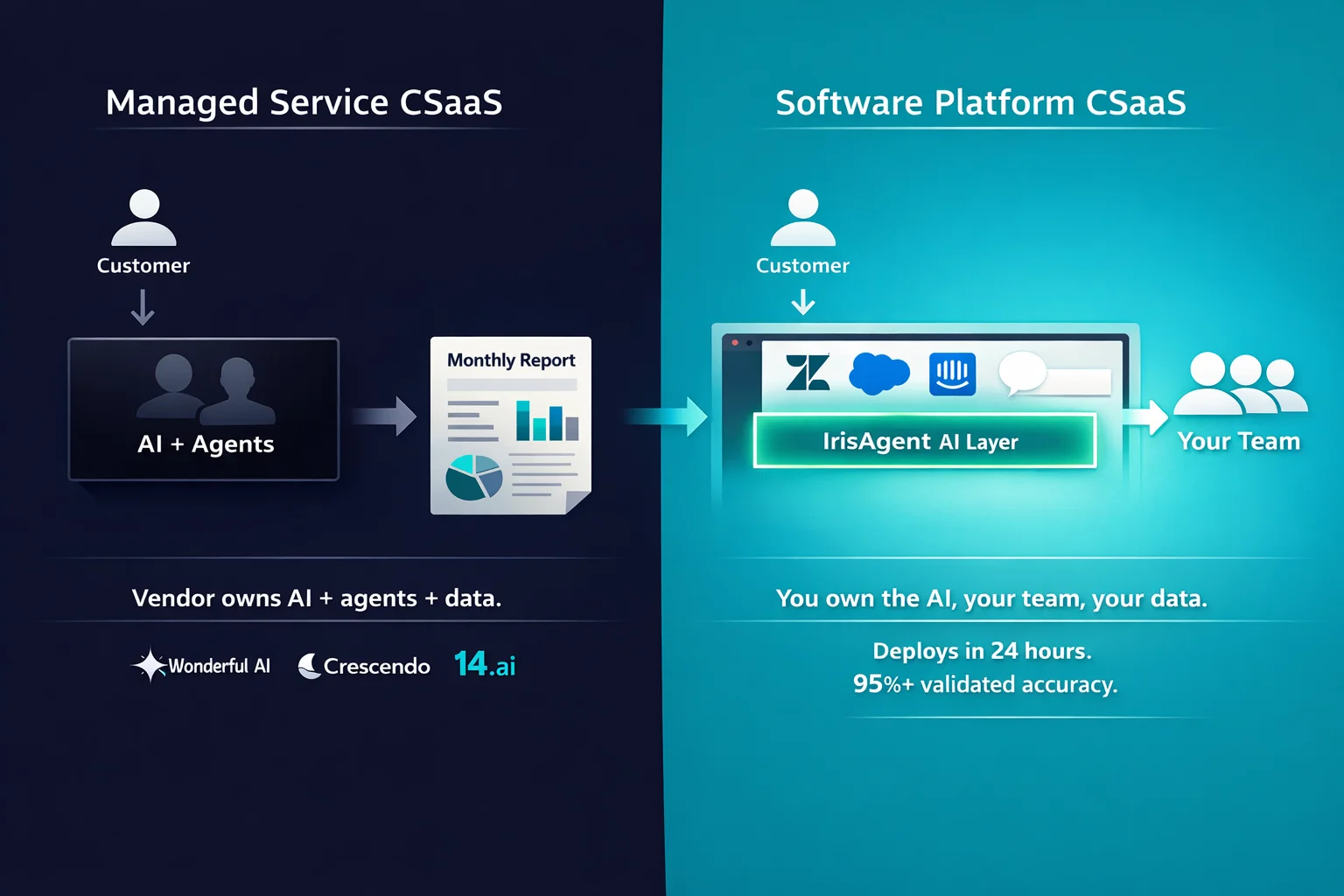
CSaaS (customer support as a service): Best when you want resolved outcomes rather than staffed seats. A CSaaS provider combines AI automation with human experts and charges for results, which suits growing teams that want to scale without building a large support organization.
Many companies land on a mix: an in-house core team that owns the customer relationship and product expertise, AI for repetitive tier 1 volume, and a BPO or CSaaS partner for overflow, after-hours, and specialized queues. To decide, ask how much of your volume is repetitive, how complex your product is, what your compliance obligations are, how sharply volume swings, and whether you would rather pay for effort or for outcomes.
How IrisAgent Works With BPOs
IrisAgent partners with BPOs rather than competing with them. Its AI agents resolve repetitive tier 1 requests automatically, answering only from verified knowledge and live data in your helpdesk, CRM, and order or billing systems, so responses are grounded and never invented. When a case needs a person, IrisAgent hands it to the right agent, in-house or outsourced, with the full conversation, customer context, and suggested next steps attached.
For BPO teams, the same platform works as a copilot: it suggests grounded answers, summarizes cases, tags and routes tickets, and flags at-risk customers. That shortens ramp time for new agents and keeps quality consistent across sites, with AI and people working from the same verified knowledge inside one CX operating system.
Learn More
See how IrisAgent delivers outcomes with AI managed support and managed resolution, or explore the IrisAgent partner program for BPOs and service providers.
For deeper reading, see What Is CSaaS (Customer Support as a Service)? and Cost Per Ticket: How to Calculate & Reduce with AI.
Frequently Asked Questions
What is BPO in customer support?
BPO (business process outsourcing) is contracting a third-party provider to run a business function under an agreed scope, service levels, and price. In customer support, the BPO supplies trained agents, team leads, workforce planning, and often the facilities and technology to answer customers by phone, email, chat, and social channels.
What is the difference between onshore, nearshore, and offshore BPO?
Onshore providers operate in the same country as the client and offer the closest language and cultural match at the highest labor cost. Nearshore providers operate in a nearby country with overlapping time zones, balancing savings with real-time collaboration. Offshore providers operate in distant, lower-cost regions and deliver the largest savings and practical 24/7 coverage, but need more investment in training and oversight.
How are BPO services priced?
The common models are per hour (paying for each agent hour), per FTE (a fixed monthly rate per dedicated agent), per transaction (a price per call, chat, email, or ticket), and outcome-based (paying for results such as resolved tickets or SLA attainment). Contracts often add setup and training fees, minimum volumes, and SLA credits, so compare quotes by effective cost per resolved ticket.
How is AI changing BPO?
AI agents now resolve much of the repetitive tier 1 work that used to fill outsourced seats, with industry estimates of roughly 40% to 70% of tier 1 volume. BPOs are shifting toward AI-augmented agents who use copilots, managed-resolution models that sell outcomes instead of hours, and higher-value human work such as complex troubleshooting, retention, and AI supervision.


Loading the form. Prefer email? Reach us at info@irisagent.com or call +1 617 249 3312.