
Zendesk QA Alternatives (2026): Choose Your QA Scope
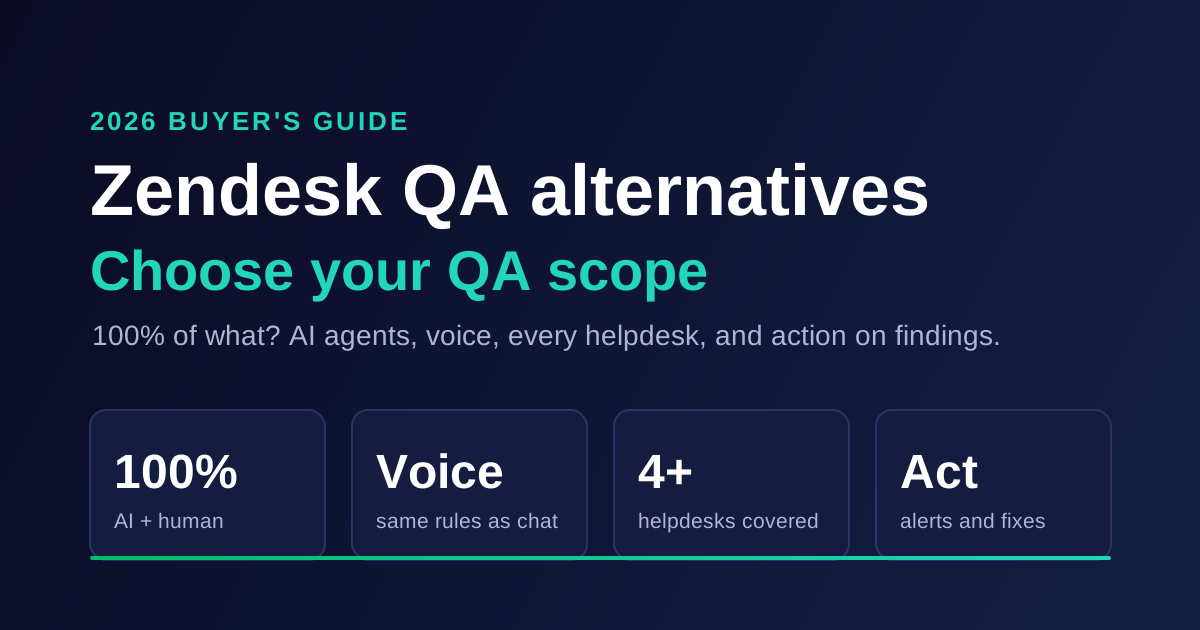
The best Zendesk QA alternatives in 2026 are IrisAgent, Rippit (formerly MaestroQA), EvaluAgent, Level AI, Observe.AI, Playvox by NICE, and ScorebuddyCX. All of them claim to score 100% of conversations. The real difference is scope: whether "100%" includes AI agent conversations, voice, helpdesks beyond Zendesk, and whether the tool acts on what it finds. IrisAgent covers all four, and teams at Dropbox, Zuora, and InvoiceCloud run on it.
Key takeaways:
"Scores 100% of conversations" is now table stakes. Zendesk QA, IrisAgent, Rippit, EvaluAgent, Level AI, and Observe.AI all make the claim, so compare what the 100% actually contains.
Zendesk QA (formerly Klaus) is the natural default for teams that live entirely in Zendesk. It is sold as a paid add-on on top of a Zendesk Support or Suite plan.
Teams look elsewhere when they run a second helpdesk (Salesforce, Intercom, Freshworks), use an AI agent from another vendor, need voice QA tied to the same rules, or want QA findings to change what the AI says tomorrow.
IrisAgent AutoQA scores every AI and human conversation against rules written in plain English, on top of Zendesk, Salesforce, Intercom, or Freshworks, and pairs the scores with AI resolution and real-time alerts.
Voice-heavy contact centers should shortlist Observe.AI, Level AI, or Playvox by NICE. Mid-size teams that want published seat pricing should look at EvaluAgent.
Why teams look beyond Zendesk QA
Zendesk QA is a strong product. Zendesk bought Klaus in 2024, folded it into the Zendesk suite, and now markets AutoQA that scores every interaction instead of a hand-picked sample. According to the Zendesk QA product page, it covers AI agent conversations alongside human ones, includes voice, ships categories like Empathy, Solution, and Tone, and lets you add custom prompt-based categories. Spotlight flags churn risk, escalations, and knowledge gaps.
So why do support leaders search for Zendesk QA alternatives at all? In our conversations with QA managers, it comes down to four scope questions.
Is all your support in Zendesk? Many mid-market teams run Zendesk for one product line and Salesforce Service Cloud or Intercom for another. A QA tool that is strongest inside one helpdesk leaves the other half graded on a different rubric, or not at all.
Is your AI agent built by Zendesk? Zendesk includes AI agent QA in the add-on, but Zendesk AI agents are sold separately. If your chatbot comes from another vendor, confirm exactly which bot conversations the QA tool can ingest and score.
Does voice run through the same rules? A QA program that scores chat in one tool and calls in another ends up with two definitions of "good."
What happens after the score? A score on a dashboard is an input. Teams with AI agents in production want a failed rule to trigger an alert, a knowledge gap fix, or a change in what the AI answers next time.
There is also cost. Zendesk QA is a per-agent add-on on top of your Zendesk plan, and third-party pricing guides quote figures that range widely depending on bundle and plan. Get a written quote before you compare.
If you want the background on why sampling fails in the first place, read why sampling 5% of conversations is costing you.
Why "100% coverage" is no longer the differentiator
Two years ago, scoring every conversation was the headline feature. Today every serious vendor claims it. So the useful question isn't "does it score 100%?" anymore. It's "100% of what?"
Here is the checklist we use to evaluate AI QA for customer support. Score each tool on all five before you sit through a demo.
AI agent conversations. Does it score your bot's conversations with the same rules as your human agents? Can it check whether an AI answer was grounded in your knowledge base, or only whether it sounded polite?
Channels. Chat, email, and tickets are standard. Voice is where tools split.
Helpdesks. Zendesk only, or Zendesk plus Salesforce, Intercom, Freshworks, and HubSpot?
Rule authoring. Can a QA manager write a new check in plain English, or does every rule need a vendor services ticket?
Action. Does a failed rule trigger anything, or does it sit in a report until the weekly calibration meeting?
Here is a composite example drawn from QA teams we talk to. Dana is a QA lead at a 400-person fintech. In March, her team ran Zendesk QA on its Zendesk chat queue and manually sampled 3% of calls from its phone system. A disclosure miss on calls ran for six weeks before a customer complaint surfaced it. The chat side was fully scored the whole time. The gap was scope, not scoring accuracy. Her fix was to move both channels onto one rule set so the disclosure check ran on every call and every chat.
Want to see what plain-English QA rules look like on your own tickets? Try IrisAgent AutoQA free.
Zendesk QA alternatives compared
Tool | Coverage scope | AI agent QA | Helpdesks | Voice | Pricing model |
|---|---|---|---|---|---|
IrisAgent AutoQA | 100% of AI and human conversations, real time | Yes, including grounding checks on AI answers | Zendesk, Salesforce, Intercom, Freshworks | Yes (calls are scored) | Free plan; Standard from $500/month; usage-based and resolution-based options |
Zendesk QA (baseline) | 100% via AutoQA | Yes; Zendesk AI agents sold separately | Zendesk native, plus legacy Klaus connectors | Yes | Paid per-agent add-on on a Zendesk plan |
Rippit (formerly MaestroQA) | 100% of connected conversation data | Yes, chatbot monitoring agents | Zendesk, Intercom, plus Gong and other sources | Via connected call tools | Self-serve sign-up with free trial |
EvaluAgent | 100% via AutoQM | Yes, priced per AI conversation | CCaaS and helpdesk agnostic | Yes | From $35 per user per month (vendor pricing page) |
Level AI | 100% via QA-GPT | Yes, bot conversations scored | Contact center and CRM integrations | Yes, voice-first | Quote only |
Observe.AI | 100% of human and AI interactions | Yes, including its own VoiceAI agents | Contact center platforms | Yes, voice-first | Quote only, enterprise focus |
Playvox by NICE | Manual plus AI-assisted QA | Limited public detail | Salesforce, Zendesk | Yes | Quote only, per agent per module |
ScorebuddyCX | AI scoring across voice, chat, email | Limited public detail | CCaaS agnostic | Yes | Quote only; ask about AI scoring credits |
Pricing and features change often. We checked each vendor's site in October 2026. Confirm current terms in writing before you buy.
The 7 best Zendesk QA alternatives
1. IrisAgent AutoQA
Best for: support teams that run AI agents in production, use more than one helpdesk, or want QA findings to change what the AI does next.
IrisAgent AutoQA scores 100% of AI and human conversations in real time against rules your QA team writes in plain English. Each rule has a severity (Critical, Warning, or Info), each conversation gets a 0 to 5 score, and every failed rule shows the explanation and the exact messages that triggered it. Chats, emails, tickets, and calls all run through the same rule set. If you have never written rules this way, see how AutoQA rules in plain English work.
Two things set it apart from Zendesk QA. First, it works on top of the helpdesk you already run, whether that is Zendesk, Salesforce, Intercom, or Freshworks, so a split stack gets one rubric.
Second, IrisAgent is also an AI resolution platform. The same system that scores conversations checks whether AI answers were grounded in your knowledge base, fires alerts when a conversation drops below a threshold (compliance misses, negative sentiment spikes, missed SLAs), and surfaces prioritized fixes for content gaps and missing data sources.
IrisAgent's Hallucination Removal Engine keeps validated answer accuracy above 95%, and teams at Dropbox, Zuora, and InvoiceCloud run on it.
Setup: connects to your helpdesk with an admin login. Most teams are live in about 24 hours.
Pricing: a Free plan to start. Standard starts at $500 per month and includes Voice AI, agent assist, and AutoQA. Usage-based and resolution-based plans are both available. See IrisAgent pricing.
Limitations: IrisAgent is not a full workforce management suite. If you need scheduling and forecasting bundled with QA, pair it with a WFM tool or look at Playvox by NICE.
For a direct product comparison, see IrisAgent vs Zendesk AI.
2. Rippit (formerly MaestroQA)
Best for: teams that want QA to sit on a broader conversation data layer shared with product, sales, and success.
MaestroQA rebranded as Rippit in 2026 and rebuilt the product as an AI conversation data platform. Per Rippit's rebrand announcement, existing rubrics, scorecards, calibration history, and Zendesk and Intercom connections carried over. Rippit now connects to helpdesks, call tools like Gong, and meeting notes, then runs AI agents across all of it: QA scoring, chatbot monitoring for wrong answers and incomplete resolutions, coaching, and churn and product feedback analysis.
Strengths: wide data scope beyond support, self-serve sign-up, plain-language checks.
Limitations: Rippit is moving toward conversation analytics for many teams, not only QA. If you want a QA tool that also resolves tickets, it is not that. Verify current pricing on its site.
3. EvaluAgent
Best for: mid-size contact centers that want published seat pricing and a dedicated QA and coaching platform.
EvaluAgent's AutoQM and Improvement plan scores 100% of conversations and starts at $35 per user per month on its pricing page. AI agent conversations are priced per conversation rather than per seat, and handovers from AI to a human are covered by the seat license. It is helpdesk and CCaaS agnostic, with strong coaching and agent engagement workflows.
Strengths: transparent starting price, coaching depth, policy-grounded scoring.
Limitations: no AI resolution layer. It tells you what went wrong, and your team fixes it.
4. Level AI
Best for: voice-heavy contact centers that want AI scoring of open-ended scorecard criteria.
Level AI's QA-GPT engine auto-scores calls, chats, emails, and bot conversations, with each score tied to the transcript evidence behind it. Evaluators can override scores, and those corrections feed future scoring. It also offers real-time agent assist and analytics.
Strengths: voice QA, evidence-linked scores, enterprise analytics.
Limitations: pricing is quote only, and independent reviewers recommend testing accuracy against your own historical calls before you trust the 100% figure.
5. Observe.AI
Best for: large contact centers that want post-call QA, real-time agent guidance, and voice AI agents from one vendor.
Observe.AI markets Auto QA across 100% of human and AI interactions, and it sells its own VoiceAI agents on the same platform. Scores link back to specific moments in the call. It is built for high-volume voice operations.
Strengths: voice depth, real-time and post-interaction tooling in one platform.
Limitations: sales-led pricing aimed at larger teams. Chat and email teams on Zendesk or Intercom may find it heavier than they need.
6. Playvox by NICE
Best for: teams that want QA bundled with workforce management and are already in the NICE ecosystem.
NICE acquired Playvox in 2024. It is known for native Salesforce Service Cloud and Zendesk integrations, and it sells quality management, WFM, and coaching as modules. Public pricing has been removed, and third-party sources describe a per-agent, per-module quote.
Strengths: QA plus WFM in one vendor, mature calibration workflows.
Limitations: less public detail on AI agent QA, and module-by-module pricing adds up.
7. ScorebuddyCX
Best for: teams that want a flexible scorecard builder across any CCaaS platform.
ScorebuddyCX (renamed from Scorebuddy in 2026) offers manual and AI scoring across voice, chat, and email, with customizable scorecards and coaching.
Strengths: scorecard flexibility, CCaaS agnostic.
Limitations: quote-only pricing. Competitors claim AI scoring runs on monthly credit allowances, which we could not verify. Ask directly whether AI scoring is capped before you assume 100% coverage.
A second composite example: Marcus runs support ops at a B2B SaaS company with Zendesk for tickets and a third-party AI agent on the website. In July, his AI agent's resolution rate looked healthy at 58%. When he scored every bot conversation against a "did the answer cite a current help article" rule, 1 in 9 resolved conversations failed. The bot was answering from a pricing page retired in May. The fix took an afternoon. Finding it took full coverage of AI conversations with a grounding check, not a sample.
Running an AI agent you cannot fully see into? Book an IrisAgent demo and we will score a week of your real conversations.
How to choose a Zendesk QA alternative
Start with scope, then shortlist. These rules of thumb cover most teams.
Everything is in Zendesk, and your AI agent is Zendesk's: stay on Zendesk QA. It is native, well built, and the add-on math is simple.
You run two helpdesks, or you plan to: choose a tool that sits on top of both. IrisAgent and EvaluAgent are helpdesk agnostic.
Your AI agent comes from another vendor: pick a tool that scores bot conversations with the same rules as humans and checks grounding. IrisAgent does both.
Voice is more than half your volume: shortlist Observe.AI, Level AI, or Playvox by NICE.
QA needs to feed product, sales, and churn analysis: look at Rippit.
You want QA to change outcomes, not just report them: choose a tool that pairs scoring with action. IrisAgent combines AutoQA with AI resolution, alerts, and knowledge gap fixes.
Then run a two-week pilot on real data. Pick 500 historical conversations your team has already graded, run them through each shortlisted tool, and compare agreement with your human reviewers. Our guide to best practices for AI-driven QA in support covers calibration in detail, and the free support quality scorecard gives you a starting rubric.
A third composite example: Priya, a support director at a consumer subscription brand, piloted three tools on the same 500 graded tickets in September. Two scored within 85% agreement of her senior reviewers. One scored 71% because it missed refund policy nuance. She picked between the top two on helpdesk coverage, since her team was moving billing tickets into Salesforce in Q1. Her decision took ten business days, not a quarter.
Where to go deeper
If you are evaluating the whole category rather than only Zendesk QA replacements, our roundup of the best AI tools for support QA and coaching covers more vendors. For the fundamentals of automated QA, start with what AutoQA is and how it works.
Conclusion
Every Zendesk QA alternative on this list claims 100% coverage. That claim alone no longer separates them. What separates them is scope: AI agent conversations with grounding checks, voice on the same rules, helpdesks beyond Zendesk, and whether a failed rule triggers a fix.
If your whole operation lives in Zendesk, Zendesk QA is a sound choice. If your stack is split, your AI agent comes from another vendor, or you want QA to change what your AI says tomorrow, IrisAgent AutoQA is built for that job. It runs on top of your existing helpdesk, scores every AI and human conversation against plain-English rules, and goes live in about 24 hours.
Try IrisAgent AutoQA free or book a demo to see it scoring your own tickets.
Frequently Asked Questions
Which Zendesk QA alternative scores 100% of conversations?
IrisAgent, Rippit, EvaluAgent, Level AI, and Observe.AI all score 100% of conversations, and Zendesk QA does too. The difference is what the 100% includes. IrisAgent scores every AI and human conversation across chat, email, tickets, and calls, on Zendesk, Salesforce, Intercom, or Freshworks, and checks whether AI answers were grounded in your knowledge base.
Is Zendesk QA the same as Klaus?
Yes. Zendesk acquired Klaus in 2024 and rebranded it as Zendesk QA. It is now sold as a paid add-on to Zendesk Support and Suite plans, with AutoQA, Spotlight, scorecards, and calibration workflows. If you are comparing Klaus alternatives, the tools in this guide are the same shortlist, because Klaus and Zendesk QA are now one product.
What is the best Zendesk QA alternative for AI agent conversations?
IrisAgent is the strongest fit when you need to QA AI agent conversations, because it scores bot and human conversations with the same plain-English rules and checks each AI answer for grounding in your knowledge base. It also flags content gaps so the AI stops repeating the same wrong answer.
Can I use a Zendesk QA alternative if I also use Salesforce or Intercom?
Yes. IrisAgent works on top of Zendesk, Salesforce, Intercom, and Freshworks, so a split helpdesk stack gets one QA rubric. EvaluAgent and ScorebuddyCX are also helpdesk and CCaaS agnostic. Zendesk QA is strongest when all support lives in Zendesk.
What happened to MaestroQA?
MaestroQA rebranded as Rippit in 2026 and moved from rubric-based QA toward an AI conversation data platform. Existing rubrics, scorecards, and Zendesk and Intercom connections carried over, and Rippit still supports QA scoring across 100% of connected conversations. Teams weighing MaestroQA alternatives after the rebrand usually compare Rippit with EvaluAgent and IrisAgent on helpdesk coverage and AI agent QA.
How much do Zendesk QA alternatives cost?
EvaluAgent publishes seat pricing from $35 per user per month. IrisAgent has a Free plan, and Standard starts at $500 per month with both usage-based and resolution-based options. Level AI, Observe.AI, Playvox by NICE, and ScorebuddyCX are quote only. Zendesk QA is a per-agent add-on on top of a Zendesk plan.

Loading the form. Prefer email? Reach us at info@irisagent.com or call +1 617 249 3312.