
Best AI Customer Support Tools for SaaS Companies in 2026
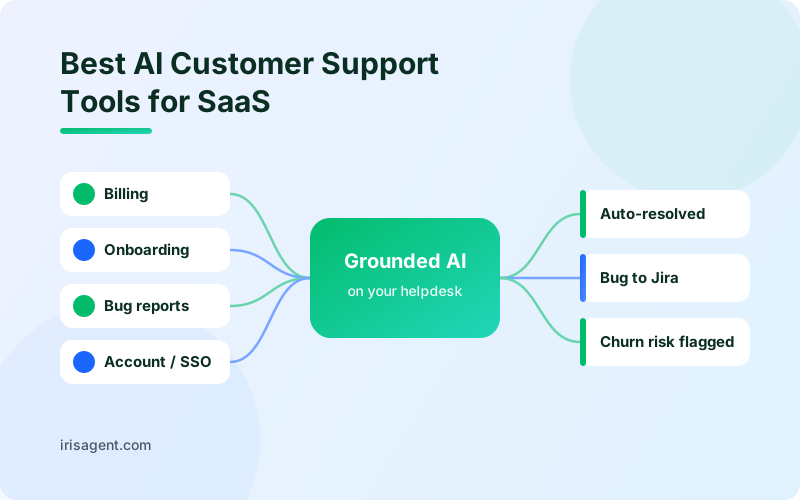
The best AI customer support tools for SaaS in 2026 are IrisAgent, Intercom Fin, Zendesk AI agents, Freshworks Freddy AI, Pylon, Decagon, and Ada. The right pick depends on your helpdesk, your B2B or B2C mix, and how much of your queue is billing, onboarding, and bugs. At InvoiceCloud, IrisAgent answers 86% of chat questions from verified knowledge.
Most "best AI support tool" lists are written for generic support teams. However, SaaS support is a different job. Your queue is full of plan changes, failed payments, SSO errors, API questions, and bug reports that need to reach engineering. This guide ranks the tools on those jobs, shows what each one costs as volume grows, and gives you a two-week pilot plan to test them on your own tickets.
What SaaS support teams actually need from AI
Answering "how do I reset my password" is table stakes. Every tool on this list does it. The difference shows up on the tickets that make SaaS support hard. In practice, five jobs separate a useful AI customer support tool from a demo:
Billing and subscription tickets. Plan upgrades, proration questions, failed card retries, and refund requests. The AI needs to read account and billing data, not just your help center. We cover this in depth in AI for subscription billing support.
Onboarding and "how do I" questions. New users ask the same setup questions in their first 30 days. Fast, accurate answers here shorten time-to-value and protect activation. See AI chatbots for SaaS onboarding.
Bug triage and engineering escalation. A SaaS support team is the front door for product defects. The AI should spot that 40 tickets describe the same bug, link them, and file or update one Jira issue instead of 40.
Churn and expansion signals. Frustrated admins, repeated outages, and "how do I export my data" questions are churn signals. Good tools surface them to customer success before the renewal call.
Grounded accuracy on product details. SaaS products change every sprint. If the AI invents a feature or a setting that does not exist, the customer files a second ticket and trusts you less.
Pricing is the sixth factor, and it matters more for SaaS than for most industries. SaaS ticket volume grows with your customer count. So a per-resolution fee that looks small at 2,000 tickets a month becomes a real line item at 20,000.
AI customer support tools for SaaS at a glance
Tool | Best for | Helpdesk model | Billing and account actions | Bug triage to engineering | Pricing model |
|---|---|---|---|---|---|
IrisAgent | Mid-market and enterprise SaaS on Zendesk, Salesforce, Intercom, or Freshdesk | Layers on your existing helpdesk | Yes, via backend integrations | Yes, duplicate-bug detection and Jira escalation | Flexible: usage-based or resolution-based |
Intercom Fin | PLG and SMB SaaS already on Intercom | Native to Intercom, also works on other helpdesks | Via custom actions | Basic, through workflows | Per resolution plus seats |
Zendesk AI agents | SaaS teams standardized on Zendesk | Native to Zendesk | Via integrations and actions | Via Jira integration | Per automated resolution beyond plan allowance |
Freshworks Freddy AI | Freshdesk teams that want native AI | Native to Freshdesk | Limited, plan-dependent | Via Jira integration | Session packs on top of seats |
Pylon | B2B SaaS supporting customers in Slack and Teams | Pylon is the helpdesk | Limited | Yes, built for B2B issue tracking | Per seat, AI add-ons |
Decagon | High-volume, consumer-scale SaaS | Standalone agent platform | Yes, custom-built workflows | Custom | Enterprise contract |
Ada | Global SaaS with heavy self-service and many languages | Standalone with integrations | Via no-code flows | Limited | Usage-based, quote-only |
The 7 best AI customer support tools for SaaS
1. IrisAgent
Best for: mid-market and enterprise SaaS teams that want grounded automation on the helpdesk they already run.
IrisAgent is an AI support platform that layers onto Zendesk, Salesforce, Intercom, and Freshdesk. It resolves routine tickets end to end, drafts grounded replies for agents on the rest, and routes every ticket by intent and account value. Because it installs from your helpdesk marketplace, most teams go live in about 24 hours with no migration.
For SaaS specifically, three things stand out. First, the Hallucination Removal Engine validates every answer against your knowledge base and past tickets before it reaches a customer. That matters when your product ships changes every two weeks. Second, IrisAgent detects when multiple tickets describe the same defect and escalates one linked Jira issue, so engineering sees the real blast radius. Third, it reads sentiment and account context to flag churn risk on enterprise accounts.
The proof comes from SaaS companies. At Zuora, IrisAgent Agent Assist addresses 30% of queries and improved mean time to resolution by up to 10x in many scenarios. At InvoiceCloud, 83% of support cases arrive with a source-backed answer ready for the agent. Dropbox runs IrisAgent to tag and auto-resolve low-complexity tickets.
Strengths: grounded answers, 24-hour deployment, bug triage to Jira, works across helpdesks
Pricing: flexible, with usage-based or resolution-based plans
Watch-out: IrisAgent augments your helpdesk. It is the wrong pick if you want to replace your system of record entirely.
2. Intercom Fin
Best for: product-led SaaS companies already running support in Intercom.
Fin is one of the strongest chat resolution agents on the market, and it is quick to stand up if your help center already lives in Intercom. Its in-app messenger fits the PLG motion well, since users ask questions inside the product. Fin can also run on top of Zendesk or Salesforce.
The trade-off is pricing. Fin charges per resolution ($0.99 at list) on top of Intercom seat fees. Consequently, your bill grows as Fin gets better at its job and as your customer base grows. Teams with complex billing or multi-step account workflows also report needing custom actions and engineering time to go beyond FAQ-style answers. We compare the two in detail in IrisAgent vs Intercom.
Strengths: excellent in-app chat, fast setup for Intercom customers
Pricing: per resolution plus seats
Watch-out: cost scales with success; complex account actions need custom work
3. Zendesk AI agents
Best for: SaaS teams that have standardized on Zendesk and want AI inside that workflow.
Zendesk has built AI agents, intelligent triage, and agent copilot features into its suite. The biggest advantage is fit. Your agents already work in Zendesk, so the AI shows up where they live. In addition, Zendesk's Jira integration gives you a path for escalating bugs.
However, the most capable features sit in higher tiers and add-ons, and automated resolutions beyond your plan allowance are billed per resolution. Answer quality also depends heavily on how well structured your Zendesk Guide content is. For a side-by-side, see IrisAgent vs Zendesk AI.
Strengths: native to Zendesk, mature triage
Pricing: per automated resolution beyond plan allowance, plus add-ons
Watch-out: best features are gated by tier; Zendesk-only
4. Freshworks Freddy AI
Best for: smaller SaaS teams on Freshdesk that want native AI at a predictable entry price.
Freddy AI adds an AI agent, agent copilot, and insights to Freshdesk and Freshchat. For existing Freshworks customers, it is the path of least resistance. Setup is quick, and the AI agent is sold in session packs, which makes early budgeting simple.
On the other hand, account-level actions and deeper workflow automation vary by plan, and quality is tied to your Freshworks knowledge base. Fast-growing SaaS teams often outgrow the native tier as their ticket mix shifts toward billing and technical issues. See IrisAgent vs Freshdesk.
Strengths: native, simple to start, accessible pricing
Pricing: session packs on top of seat licenses
Watch-out: capability varies by plan tier
5. Pylon
Best for: B2B SaaS companies whose customers expect support in shared Slack or Microsoft Teams channels.
Pylon is a helpdesk built for B2B support. It turns Slack Connect and Teams messages into tickets, tracks account health, and adds AI agents for answers and triage. If your enterprise customers live in shared channels, Pylon fits that motion better than a traditional helpdesk.
The trade-off is that Pylon is a helpdesk replacement, not a layer. Moving to it means migrating your ticket history, macros, and reporting. It is also newer to high-volume email and chat resolution than the established players.
Strengths: built for B2B shared channels, account-centric views
Pricing: per seat, with AI features as add-ons
Watch-out: requires switching helpdesks
6. Decagon
Best for: high-volume, consumer-scale SaaS with engineering capacity to build custom workflows.
Decagon builds AI agents around natural-language agent operating procedures and is popular with large consumer software brands. It handles complex, multi-step workflows well when they are built carefully.
That said, Decagon is an enterprise commitment. Implementations commonly run about six weeks, contracts are enterprise-sized, and the platform works best when it replaces your existing front line. Mid-market SaaS teams usually find the cost and timeline hard to justify. See IrisAgent vs Decagon.
Strengths: deep custom workflows at very high volume
Pricing: enterprise contract
Watch-out: long implementation, high floor
7. Ada
Best for: global SaaS companies with heavy self-service volume across many languages.
Ada lets non-engineers build automated flows and supports a long list of languages. That makes it a common choice for SaaS companies with a large international user base and a self-service-first support model.
The caveats are knowledge ingestion and economics. Ada's accuracy depends on how carefully you build and maintain content, and pricing is usage-based and quote-only, so costs climb with volume. See IrisAgent vs Ada.
Strengths: no-code builder, broad language coverage
Pricing: usage-based, quote-only
Watch-out: verify ingestion of your docs sources and model costs at scale
Which AI customer support tool fits your SaaS stage
The right choice tracks your stage and your helpdesk more than any feature list. Here is a quick way to narrow the field:
Seed to Series A, PLG, on Intercom: start with Fin. Revisit the economics once monthly resolutions reach the thousands.
Small team on Freshdesk: turn on Freddy AI first, then evaluate a layered tool when billing and technical tickets dominate.
B2B SaaS supporting customers in Slack: look at Pylon, and accept the helpdesk migration that comes with it.
Mid-market or enterprise SaaS on Zendesk, Salesforce, Intercom, or Freshdesk: evaluate IrisAgent alongside your helpdesk's native AI. Compare resolution accuracy on billing and bug tickets, not just FAQs.
Consumer-scale SaaS with a large engineering budget: Decagon or Sierra, if you can absorb a long implementation.
Global self-service at scale: Ada, if language coverage is your top constraint.
For a broader comparison that includes Salesforce Agentforce and Kustomer, see our guide to the best AI customer support automation software.
What AI customer support costs at SaaS volumes
Pricing models matter because SaaS ticket volume compounds with growth. To illustrate, take a SaaS company handling 10,000 tickets a month with a 20-person support team.
At a 40% AI resolution rate, that is 4,000 resolutions a month. At $0.99 per resolution, the resolution fee alone is about $3,960 a month, before seats.
Raise the resolution rate to 60% and the same fee becomes about $5,940 a month. The tool got better, and the bill went up 50%.
Double the customer base to 20,000 tickets a month at 60% and the fee reaches about $11,880 a month.
None of this makes per-resolution pricing wrong. It is easy to start and ties cost to value. However, it does mean you should model cost at your 12-month and 24-month volume, not today's. IrisAgent offers both usage-based and resolution-based plans so you can pick the structure that fits your growth curve. Our SaaS support automation ROI guide walks through the full payback math, including agent hours saved.
How to run a two-week pilot
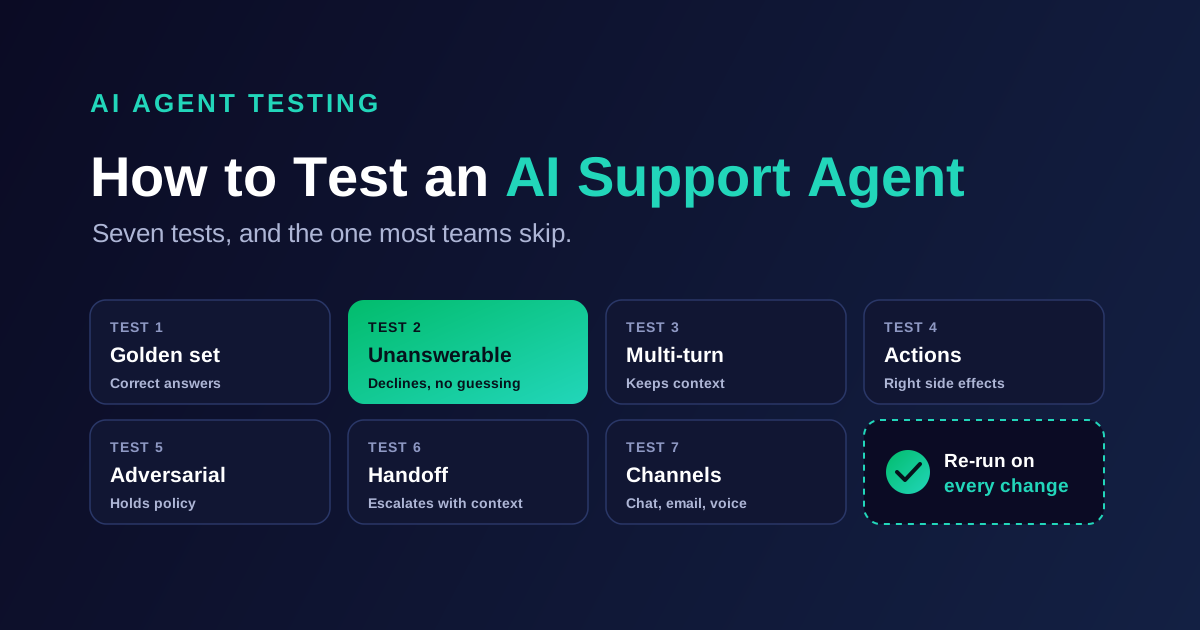
Vendor resolution claims are measured on vendor-chosen tickets. Your own queue is the only benchmark that counts. So run every shortlisted tool through the same test:
Pull 100 real tickets from last month. Include 25 billing tickets, 25 onboarding questions, 25 bug reports, and 25 account or admin requests.
Connect each tool to the same knowledge base. Same help center, same internal docs, same past tickets.
Score accuracy, not just deflection. For each ticket, mark the answer correct, wrong, or "admitted it did not know." A wrong answer costs more than an escalation.
Test one real action. Ask each tool to complete a plan change or refund request through your billing system.
Send 10 tickets about the same bug. Check whether the tool links them and escalates one engineering issue.
Model cost at 2x your current volume. Use the vendor's actual price sheet.
Ask agents to rate the drafted replies. Agent adoption decides whether agent assist pays off.
A tool that scores well on steps 3, 4, and 5 will hold up on a real SaaS queue. In contrast, a tool that only wins on FAQ deflection will plateau within a quarter.
Next steps
Choosing AI customer support tools for SaaS comes down to three questions. Does it answer billing, bug, and account tickets accurately? Does it work on the helpdesk you already run? And will the pricing still make sense at twice your current volume?
Start by pulling 100 real tickets and running the pilot above. If you run support on Zendesk, Salesforce, Intercom, or Freshdesk, see how IrisAgent handles SaaS support and test it on your own queue in a 20-minute demo.
Frequently Asked Questions
What is the best AI customer support tool for SaaS companies?
The best AI customer support tool for SaaS depends on your helpdesk and stage. IrisAgent fits mid-market and enterprise SaaS teams that want grounded automation on Zendesk, Salesforce, Intercom, or Freshdesk, with bug triage to Jira and flexible pricing. Intercom Fin suits PLG teams already on Intercom. Pylon suits B2B teams that support customers in Slack.
How is SaaS customer support different from other support?
SaaS customer support handles a recurring relationship, not a one-time purchase. Tickets skew toward billing and plan changes, onboarding, integrations, API errors, and bug reports. As a result, SaaS teams need AI that reads account data, escalates defects to engineering, and spots churn signals, not just AI that answers FAQ questions.
How much of SaaS support can AI automate?
Most SaaS teams can automate 40% to 60% of incoming tickets once the knowledge base is solid, with the highest rates on onboarding and how-to questions. Billing actions and bug reports need backend and Jira integrations to automate. IrisAgent customers such as InvoiceCloud answer 86% of chat questions from verified knowledge.
Is per-resolution pricing a good fit for SaaS?
Per-resolution pricing is easy to start with and ties cost to value. However, SaaS ticket volume grows with your customer base, so the bill grows as both volume and AI accuracy rise. Model cost at 2x your current volume before signing. IrisAgent offers both usage-based and resolution-based plans.
Do I need to switch helpdesks to use AI for SaaS support?
No. Native options like Fin, Zendesk AI agents, and Freddy AI run inside their own helpdesks, and IrisAgent layers onto Zendesk, Salesforce, Intercom, and Freshdesk without a migration. Pylon and Decagon are the main options on this list that work best when they replace your current front line.
How long does it take to deploy AI customer support for SaaS?
Deployment ranges from about a day to several months. IrisAgent and native helpdesk AI typically go live within days because they connect to your existing knowledge base and tickets. Custom agent platforms like Decagon commonly take around six weeks, and longer for complex workflows.
Loading the form. Prefer email? Reach us at info@irisagent.comor call +1 617 249 3312.