
How to Replace Your IVR with AI Voice Agents: An Enterprise Migration Playbook
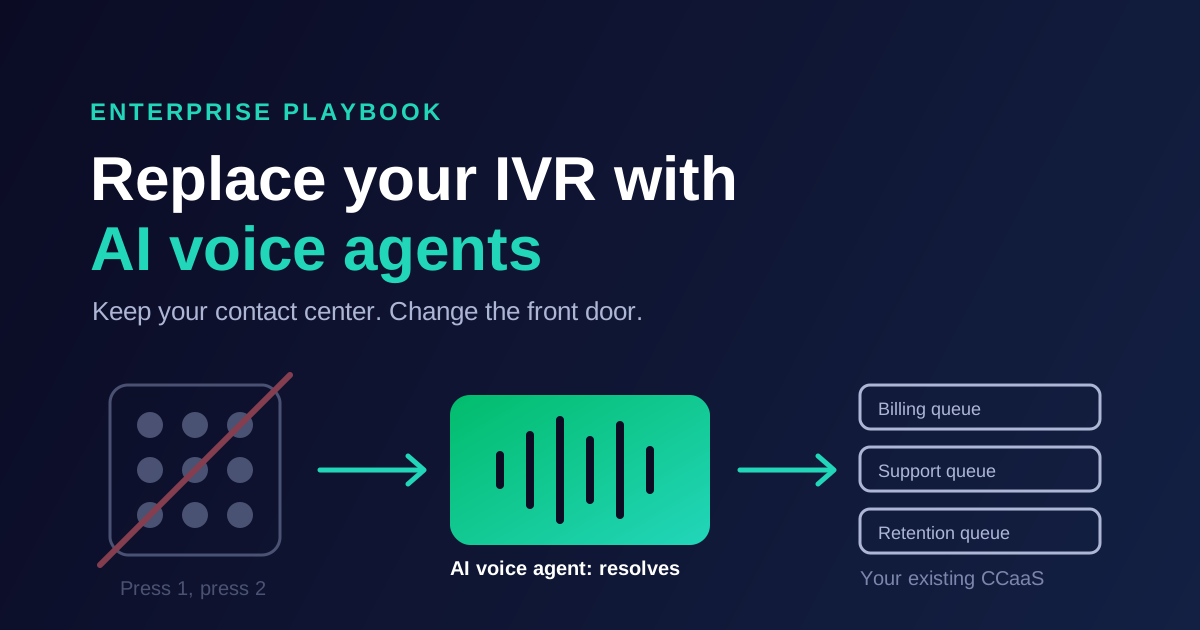
To replace your IVR with AI, you do not need to replace your contact center. Put an AI voice agent in front of the phone system you already run (Genesys, Five9, Amazon Connect, Talkdesk, NICE), let it answer in natural speech, resolve the routine calls end to end, and hand everything else to the right queue with the caller's intent and identity already captured. Start with three to five high-volume, low-risk call types, hold latency under one second per turn, keep card numbers out of the AI's audio path, and measure resolution, not containment. Most enterprises can run that cutover in 90 days without touching their carrier contracts or agent desktops.
This playbook is for contact center, CX, and IT leaders who own a touch-tone or speech IVR and are being asked to "put AI on the phones" this fiscal year. It covers why legacy IVR fails, the two migration architectures, how to pick the first call types, the latency and compliance numbers that matter, how to measure honestly, a 30/60/90-day plan, and the TCO math at 100,000 calls a month.
If you are earlier in the process and want definitions first, start with what voice AI is and how telephony works. If you already know you want a vendor shortlist, see the vendors to evaluate near the end of this guide, or our full comparison of the best AI voice bots for customer service.
Why touch-tone and speech IVR fail
IVR was built to route calls, not to resolve them. Its job is to sort callers into queues using a fixed tree of menus, and every failure mode comes from that design.
Callers fight the menu. In an eGain survey of 500 consumers who had used an IVR in the previous 12 months, 88% said the IVR was not intelligent enough, 60% said they tried to "zero out" to an agent often or very often, and 67% said they wrestled with the IVR for five minutes or more to get an answer (eGain, State of IVR Customer Experience). Self-service in general has the same problem: Gartner's survey of 5,728 customers found only 14% of service issues are fully resolved in self-service (Gartner, August 2024).
Those numbers show up in your operation as three costs:
Misroutes. A caller who picks "billing" for what is really a cancellation lands in the wrong queue, waits, and gets transferred. Each misroute costs a second wait, a second greeting, and a second round of identity verification. You can measure your own misroute rate today: count transfers between queues within the first two minutes of agent talk time, divided by agent-handled calls.
Abandonment. Callers who give up in the menu or in the post-menu queue either call back (doubling volume) or churn. Pull abandonment by IVR node, not just overall. The node with the highest drop-off is usually your first migration target.
Re-verification. Most IVRs collect an account number, then the agent asks for it again because the data was not passed to the desktop. That is 20 to 60 seconds of handle time on nearly every call, and you can time it in a sample of recordings.
Conversational or "speech-enabled" IVR fixed the input problem (callers can say "billing" instead of pressing 2) but not the resolution problem. It is still a router with a better ear.
Conversational IVR vs AI voice agent
The terms get blurred in vendor marketing, so pin them down before you write an RFP.
Capability | Touch-tone IVR | Conversational (speech) IVR | AI voice agent |
|---|---|---|---|
Input | Keypad (DTMF) | Keywords or short phrases | Free-form natural speech |
Understanding | Fixed menu paths | Intent from a trained grammar or NLU model | Intent plus context across a multi-turn conversation |
Outcome | Routes the call | Routes the call, sometimes completes a simple lookup | Resolves the request end to end, routes only when needed |
Backend actions | Scripted lookups | Scripted lookups | Reads and writes CRM, billing, order, and helpdesk systems |
Interruption (barge-in) | Rarely | Partial | Expected, mid-sentence |
Change process | Re-build call flows | Retrain grammar, re-build flows | Update knowledge and policies, test, deploy |
The practical test: if the system's best outcome is "transfer to the correct queue," it is an IVR, however good its speech recognition is. If it can answer "where is my refund," check the payment system, explain the status, and offer to reissue it, it is an AI voice agent.
Overlay vs rip-and-replace: pick the architecture first
There are two ways to replace IVR with AI, and the choice decides your timeline, budget, and risk.
Rip-and-replace means moving to a new CCaaS platform that bundles its own AI agent, then migrating numbers, routing, agent desktops, WFM, recording, and reporting. It makes sense if your CCaaS contract is ending anyway or the platform is genuinely end of life. It turns an AI project into a 9 to 18 month platform migration, and the AI is the last thing to go live.
Overlay means keeping your telephony, routing, and agent desktop exactly where they are and putting the AI voice agent in front of them. Calls hit the AI first (via SIP transfer, a CCaaS bot connector, or a number forward). The AI resolves what it can and hands the rest back into your existing queues with a summary, the detected intent, and verified identity attached. Your agents keep their desktop. Your WFM, recording, and QA keep working. The IVR's call flows are retired one branch at a time.
Dimension | Rip-and-replace | Overlay |
|---|---|---|
What changes | CCaaS, routing, desktop, reporting, and the IVR | Only the front door of the call |
Typical time to first live call | Months, after platform migration | Days to weeks |
Carrier and number porting | Usually required | Not required |
Agent retraining | New desktop and workflows | None beyond handoff summaries |
Rollback | Hard | Route the number back to the IVR |
Best when | Contract renewal or platform end of life | You want AI resolution this year without a migration |
This is the approach IrisAgent takes: IrisAgent voice AI layers onto the phone system you already run (Genesys, Five9, Amazon Connect, Talkdesk, NICE, and others), grounds every answer in your knowledge base, tickets, and backend data, and writes the outcome back to your helpdesk ticket if you have one. If you are weighing the contact center platform decision itself, our CCaaS explainer covers the economics of each shape.
Overlay has one requirement teams underestimate: the handoff. If the AI transfers a call without passing context, you have built a more expensive IVR. Before you sign, confirm the vendor can pass intent, a summary, and authentication status into your CCaaS as call-attached data that the agent desktop actually displays.
Which call types to migrate first
Do not migrate the whole IVR at once. Migrate call types, in order of value divided by risk.
Pull 90 days of call data and build a simple table: call reason (from IVR selections, dispositions, or a sample of transcripts), monthly volume, average handle time, transfer rate, and whether resolving it requires a backend action. Then score each reason on three questions:
Is it high volume? The top five to ten reasons usually account for the majority of calls.
Is the answer deterministic? "Where is my order" has one right answer in your order system. "I want to dispute this charge and also complain" does not.
Is the action reversible and low risk? Rescheduling an appointment is reversible. Closing an account or moving money is not.
Call types that usually score well for a first wave:
Order, shipment, or claim status
Appointment booking, rescheduling, and cancellation
Balance, payment status, and due-date questions
Password reset and account unlock
Store hours, policy, and FAQ questions
Address or contact detail updates (with verification)
Call types to hold for a second or third wave: disputes, collections, cancellations with retention offers, complex technical troubleshooting, and anything with a regulated disclosure you have not yet scripted and tested.
Our voice AI benchmarks from production deployments show why the order matters: resolution rates on narrow workflows like password resets run far higher than on complaints and escalations. Starting with the easy wins gives you a clean baseline and executive confidence before you touch the hard calls.
Latency and barge-in targets
On the phone, latency is the product. A caller will forgive an imperfect sentence. They will not forgive a pause long enough to wonder whether the line dropped.
Two reference points set the bar. Conversation research across ten languages found that people minimize silence between turns, with average gaps varying by less than a quarter second across languages (Stivers et al., PNAS, 2009). And the ITU-T G.114 recommendation on network delay treats one-way transmission delay below 150 ms as having no significant effect on most voice applications (ITU-T G.114). Your AI stack adds speech recognition, model reasoning, retrieval, and speech synthesis on top of network delay, so the budget is tight.
Set these as acceptance criteria in your pilot, measured on real calls through your actual telephony path, not a vendor demo line:
Metric | Target | How to test |
|---|---|---|
Response latency (caller stops speaking to first AI audio) | Under 1 second at p50, under 1.5 seconds at p95 | Measure from call recordings with timestamps, not vendor dashboards |
Barge-in stop time (caller starts speaking to AI audio stopping) | Under 300 ms | Interrupt the agent mid-sentence, repeatedly, in a frustrated tone |
Latency under load | p95 stays within target at your peak hour concurrency | Load test at your real peak concurrent calls, not average |
Backend action latency | Fill phrases ("let me pull that up") for any lookup over 1 second | Test against production APIs, not mocks |
Transfer time | Caller hears an agent or queue message within 5 seconds of handoff | Place test calls into each target queue |
Ask every vendor for p95 numbers, not averages. Averages hide the calls that go silent for three seconds, and those are the ones your callers remember.
PCI and HIPAA on the phone line
Compliance is where IVR replacement projects stall, usually late, after the pilot already looks good. Settle it in week one.
PCI DSS (card payments). The cleanest design keeps card numbers out of the AI's audio and transcripts entirely. When a caller needs to pay, the AI hands the payment step to a PCI-compliant capture method your CCaaS or payment provider already supports, such as DTMF masking, a secure IVR payment segment, or a payment link sent by SMS, then resumes the conversation once it receives a token or confirmation. The PCI Security Standards Council's information supplement on protecting telephone-based payment card data covers how DTMF, recordings, and pause-and-resume approaches affect scope (PCI SSC document library). Confirm with your QSA that the AI vendor, its speech-to-text provider, and its logs are out of scope, and that transcripts are redacted if a caller reads a card number aloud anyway.
HIPAA (protected health information). If the AI will hear or speak PHI (appointment details, medications, claims), you need a Business Associate Agreement with the AI vendor, and the vendor needs BAAs with any subprocessors that touch audio or transcripts, including speech recognition and model providers. Ask where audio and transcripts are stored, for how long, who can access them, and how deletion works. Our page on HIPAA-compliant healthcare support AI covers the controls we apply.
Everything else. Verify identity before disclosing account data, the same way your agents do. Script and test required disclosures (call recording notices, collections language, financial disclaimers) as hard rules, not suggestions. And QA every call, not a sample: IrisAgent's AutoQA scores 100% of AI and human calls against your compliance rules, so a missed disclosure surfaces the same day instead of in a quarterly audit. IrisAgent operates under SOC 2 Type II controls and signs BAAs for healthcare deployments.
Measuring containment honestly vs deflection
Here is where most IVR replacement business cases go wrong. "Containment" in IVR reporting means the call ended without reaching an agent. A caller who hangs up in frustration is contained. A caller who gets the wrong answer and calls back tomorrow is contained twice.
Report four numbers together, by call type:
Resolution rate: calls where the caller's issue was actually solved with no human, confirmed by no repeat contact on the same issue within 7 days.
Containment rate: calls that ended without an agent, for comparison with your old IVR reporting.
Transfer rate and transfer quality: share of calls handed off, and whether the agent received intent and identity (so the caller did not repeat themselves).
Repeat contact rate: callers who contact you again about the same issue within 7 days, across any channel.
The gap between containment and resolution is your hidden failure rate. Our 2026 voice AI benchmarks explain why a high containment number can hide a much lower resolution number, and our guide to AI deflection rate shows how to stop deflection from masking abandoned callers. Write the definitions into your contract. If a vendor's pricing or success criteria are based on containment, you are paying for hang-ups.
A 30/60/90-day cutover plan
This plan assumes the overlay architecture and a phone operation of roughly 50,000 to 250,000 calls a month. Adjust the dates, not the order.
Days 1 to 30: baseline, connect, and shadow
Pull 90 days of call data and rank call reasons as described above. Pick three to five for wave one.
Baseline today's numbers for those call types: volume, AHT, transfer rate, misroute rate, abandonment by IVR node, repeat contact rate, and CSAT.
Connect the AI agent to your telephony (SIP or CCaaS connector) on a test number, and to the backend systems wave one needs (order, scheduling, billing, helpdesk).
Load the knowledge the AI will ground on: KB articles, policies, and resolved tickets for those call types. Fix the gaps it exposes. Missing or contradictory articles are the top cause of wrong answers.
Settle PCI, HIPAA, identity verification, and disclosure rules with security and legal.
Run internal test calls and scripted adversarial calls (interruptions, accents, background noise, off-topic requests). Hit the latency targets before any customer hears the agent.
Days 31 to 60: controlled live traffic
Route 5% to 10% of wave-one calls to the AI, for example one phone number, one region, or after-hours only. Keep the IVR as the fallback path.
Review every AI call for the first two weeks with AutoQA or your QA team. Tag every wrong answer, slow turn, and bad transfer, and fix the knowledge or policy behind it.
Validate the handoff with agents directly: are summaries accurate, is identity passed, is the call landing in the right queue?
Expand to 25% to 50% of wave-one traffic once resolution and CSAT match or beat the human baseline for those call types.
Days 61 to 90: cut over and retire IVR branches
Move 100% of wave-one call types to the AI as the front door. Retire the IVR branches that served them, but keep the flows exported so you can roll back.
Start wave two (the next three to five call types) using the same shadow, controlled, cut-over sequence.
Report the four metrics (resolution, containment, transfer quality, repeat contact) weekly against the baseline, by call type.
Rebalance staffing and WFM forecasts for the reduced agent volume. Do this last, from measured results, not projections.
TCO math at about 100,000 calls a month
Every number below is an assumption for illustration. Replace them with your own baseline from days 1 to 30, or run them through our ROI calculator.
Assumptions:
100,000 inbound calls per month
Today's IVR fully self-serves 20% of calls (20,000); 80,000 reach an agent
Average handle time: 6 minutes
Fully loaded agent cost: $1.00 per agent minute
Misroute rate: 15% of agent calls, each adding 2 minutes of agent time
After the overlay reaches wave two (around day 90): the AI fully resolves 35% of all calls (35,000), including the 20,000 the IVR used to contain plus 15,000 taken from the agent queue
Context-rich handoffs save 30 seconds of re-verification per agent call, and misroutes fall to 5%
AI cost on a resolution-based plan: $2 per fully resolved call, nothing charged on handoff (IrisAgent's current Voice resolution-based rate; see voice AI for current terms)
Monthly cost line | Today (IVR) | With AI voice agent overlay |
|---|---|---|
Agent-handled calls | 80,000 | 65,000 |
Agent minutes | 480,000 (6.0 min AHT) | 357,500 (5.5 min AHT) |
Agent cost | $480,000 | $357,500 |
Misroute minutes and cost | 24,000 min, $24,000 | 6,500 min, $6,500 |
AI resolution fees | $0 | $70,000 (35,000 x $2) |
Total | $504,000 | $434,000 |
Under these assumptions the overlay saves about $70,000 a month, or about $840,000 a year, before counting abandoned calls recovered, after-hours coverage, or any IVR maintenance retired. Telephony and CCaaS costs are left out because the overlay keeps them unchanged.
Two lessons fall out of the math:
The savings come from the agent queue, not the IVR's existing containment. In this model, 20,000 of the 35,000 resolved calls were already self-served by the IVR at near-zero marginal cost. Paying a resolution fee on them adds cost without removing any agent minutes. That is why call-type selection matters more than headline resolution rate: aim the AI at calls that currently reach agents.
The pricing model should match your call mix. IrisAgent offers both usage-based and resolution-based pricing. Resolution-based pricing aligns cost with outcomes and charges nothing when a call is handed off. Usage-based pricing can cost less when you have a large volume of short, simple calls that the IVR already handles. Model both against your own call mix before you sign, with any vendor.
Vendors to evaluate
This is a short orientation, not a ranking. For pricing, languages, deployment times, and detailed pros and cons, see our full comparison of the best AI voice bots for customer service and the best AI call center software.
Vendor | Product shape | Works in front of your existing CCaaS? | What to check in the RFP |
|---|---|---|---|
IrisAgent | Grounded AI voice agent overlay, with AutoQA on every call | Yes: layers onto your current phone system and writes back to your helpdesk | Usage-based vs resolution-based pricing against your call mix |
Cresta | AI Agent plus agent assist for large contact centers | Yes: integrates with NICE, Genesys, Five9, Amazon Connect, and others, per its site | Custom pricing by deployment scope; published containment figures are customer-specific |
Replicant | Conversation Automation for high-volume phone operations | Yes: integrates with Genesys, Talkdesk, Five9, NICE, Amazon Connect, 8x8, and others | Pricing not public; ask how resolution is measured, not just containment |
Talkdesk (CXA, Autopilot) | Customer Experience Automation layer and agentic virtual assistant | Yes: Talkdesk says its CXA AI Gateway can sit on top of third-party contact centers | Pricing not public; confirm what runs standalone vs inside Talkdesk CCaaS |
Five9 Voice AI Agents (Genius AI) | Voice AI agents built natively into Five9's CCaaS | Best fit if you already run, or plan to run, Five9 | Pricing not public; confirm costs inside your Five9 contract |
NiCE AI Agents (Cognigy) | Agentic self-service, part of CXone or standalone | Cognigy is offered both inside CXone and standalone | Confirm which third-party CCaaS integrations are supported today |
PolyAI, Parloa | Standalone enterprise voice agent specialists | Typically connect to existing telephony; confirm per deployment | See the voice bots comparison for pricing and language detail |
Vendor details above were checked against each vendor's own website in October 2026. None of the enterprise CCaaS vendors publish list pricing, so plan for a quote process.
Common mistakes to avoid
Migrating the menu tree instead of the call reasons. Recreating "press 1 for billing" in natural language gives you a slower IVR. Design around what callers need resolved.
Skipping the baseline. Without days 1 to 30 numbers, you cannot prove the AI worked, and you cannot catch the call types where it made things worse.
Buying on containment. Contract on resolution, with repeat contact as the check.
Treating the handoff as an afterthought. A transfer without context is the most expensive call in your operation.
Letting the AI guess. On a phone call there is no link for the caller to double-check. Ground every answer in your own knowledge and systems, and QA every call.
Bottom line
Replacing your IVR with AI is a front-door change, not a platform migration. Keep the contact center you have, put a grounded AI voice agent in front of it, migrate call types in waves, hold latency under a second, keep card data out of the AI path, and measure resolution instead of containment. Done in that order, a 90-day cutover is realistic for most enterprise phone operations.
If you want to see what that looks like on your own call data, book a demo of IrisAgent voice AI and we will map your top call reasons to a wave-one plan.
Frequently Asked Questions
Can I replace my IVR with AI without changing my CCaaS platform?
Yes. In an overlay deployment the AI voice agent sits in front of your existing telephony and CCaaS (Genesys, Five9, Amazon Connect, Talkdesk, NICE, and others), resolves routine calls, and hands the rest into your current queues with intent and identity attached. Numbers, routing, agent desktops, and recording stay where they are, and you can roll back by routing the number to the IVR again.
What is the difference between conversational IVR and an AI voice agent?
Conversational IVR lets callers speak instead of pressing keys, but its job is still to route the call to a queue. An AI voice agent understands free-form speech across a multi-turn conversation, takes actions in your backend systems such as checking an order or rescheduling an appointment, and resolves the request end to end, routing to a human only when needed.
How long does it take to replace an IVR with AI voice agents?
With an overlay approach, most enterprises can go from baseline to full cutover of the first wave of call types in about 90 days: 30 days to baseline, connect, and test, 30 days of controlled live traffic, and 30 days to cut over and start the next wave. A rip-and-replace CCaaS migration usually takes much longer because the platform has to move before the AI goes live.
Which calls should move from IVR to AI first?
Start with high-volume call types that have deterministic answers and low-risk, reversible actions: order or claim status, appointment scheduling, balance and payment status, password resets, and policy questions. Hold disputes, cancellations with retention offers, collections, and complex troubleshooting for later waves, once you have a measured baseline.
How do AI voice agents handle PCI and HIPAA on phone calls?
For card payments, the AI hands the payment step to a PCI-compliant capture method such as DTMF masking or a secure payment link, so card numbers never enter the AI's audio or transcripts. For healthcare, the AI vendor and every subprocessor that touches audio or transcripts, including speech recognition and model providers, should sign a Business Associate Agreement, with clear retention and deletion controls.
What latency should an AI voice agent hit?
Target under 1 second from the caller finishing a sentence to the first AI audio at the median, under 1.5 seconds at p95, and under 300 ms to stop speaking when the caller interrupts. Measure on real calls through your own telephony at peak concurrency, not on a vendor demo line, and ask vendors for p95 numbers rather than averages.

Loading the form. Prefer email? Reach us at info@irisagent.com or call +1 617 249 3312.