
Best Multilingual AI Customer Support Platforms (2026)
Last updated: November 2026
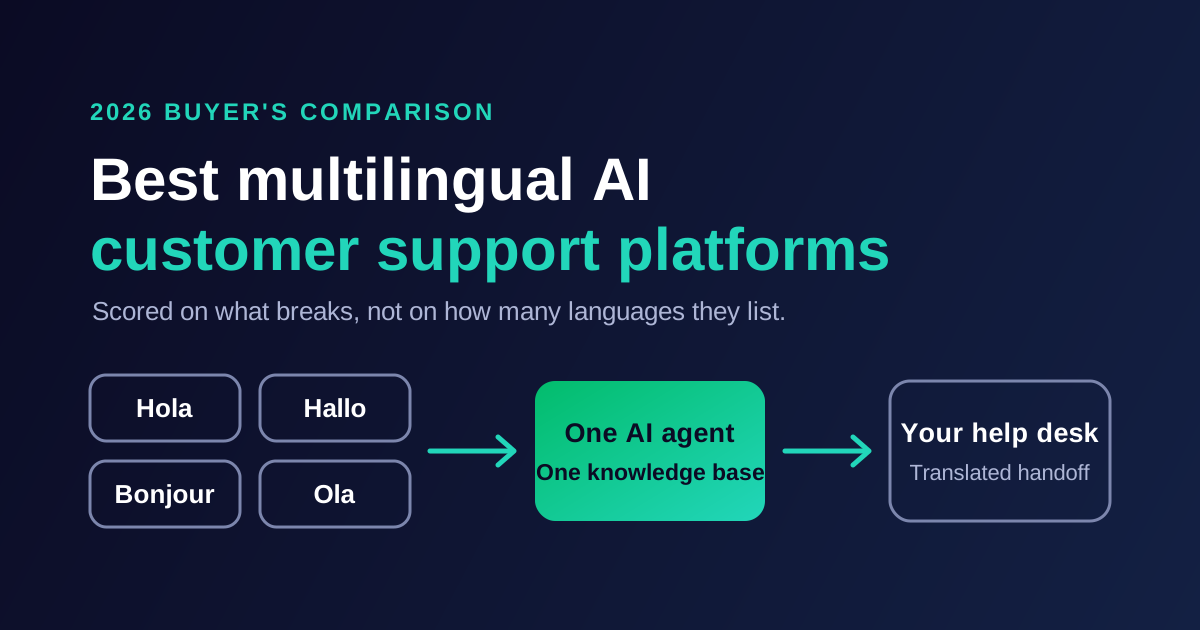
The best multilingual AI customer support platforms in 2026 are IrisAgent, Ada, Fin by Intercom, Zendesk AI, Sierra, Decagon, Cognigy, Yellow.ai, Google Conversational Agents, and Freddy AI by Freshworks. The right pick depends less on how many languages a vendor lists and more on what your stack looks like and where your volume sits. IrisAgent fits teams that want one grounded AI agent on the help desk they already run. Ada, Sierra, and Decagon fit enterprises buying a standalone agent platform. Cognigy and Google fit teams building for contact centers.
Every vendor on this list advertises dozens of languages, so the number won't separate them. Here's what will: a Spanish customer who types "hola, mi pedido no llega" and gets an English reply, or an agent who receives a translated handoff with the customer's account details stripped out. Those failures don't show up on a pricing page.
You already know you need support beyond English. This guide shows you which platform holds up after launch. We score each one on six things that actually break, compare them in one table, and give you a checklist for testing any vendor in your top 3 languages before you sign.
Key Takeaways
- Language counts vary by channel. Ada lists 60 languages for chat and email but a smaller set for voice, and Zendesk's voice AI listed 10 live languages in its April 2026 early access notice.
- Detection timing matters. Fin detects language once per conversation, while IrisAgent detects it on each inbound message and Decagon says it switches mid-sentence.
- Quality differs by language even on the same model. Sierra's τ-i18n benchmark found Spanish, Hindi, and Portuguese trail English on task completion by 2.4, 3.8, and 6.4 points on average.
- One agent grounded in one knowledge base is far easier to maintain than a bot per locale, because a policy change ships everywhere at once.
- Run a test in your top 3 languages using real tickets before signing. It takes about a week and exposes more than any demo.
How we built this list, and our bias. We make IrisAgent, so weigh our placement accordingly. We didn't run a blind test, and we'd be skeptical of any vendor that says its own ranking is independent. This comparison comes from each vendor's public documentation and product pages, reviewed in November 2026, with links so you can check the claims yourself. Where the docs were silent, we say so.
Want to see the first of these tests on your own tickets? Get a demo of IrisAgent with sample tickets in your languages.
What Actually Breaks in Multilingual AI Support
Most multilingual chatbot roundups rank by language count. That's the least useful number in the category, because a language can be "supported" in chat, weak on voice, and missing from the translation layer your agents use. These are the six criteria we used instead.
1. Language detection. When does the system decide what language the customer speaks, and can it change its mind? A platform that detects once from the first message will get stuck when a customer opens with "hi" and continues in German. It also struggles with short messages and code-switching (Spanglish, Hinglish).
2. One agent or one per locale. Some platforms run one agent across languages. Others require localized flows, intents, or training phrases per market. The second model looks fine at 3 languages and becomes a maintenance job at 15, because every policy change has to ship everywhere.
3. Context through a translated handoff. When the AI escalates, does the human get the full conversation in their own language, with a summary, routed to the right team? This is where customers feel the seam. A translated transcript without the account context forces them to repeat themselves.
4. CSAT and accuracy reported per language. A healthy blended CSAT can hide a much lower score in a single language. If you can't segment resolution rate, CSAT, and accuracy by language, you won't see the problem until a regional manager escalates it.
5. Speech versus text quality. Voice is a different product from chat. Speech recognition, accents, and latency all vary by language, so voice coverage is usually narrower than text coverage. Sierra's τ-i18n benchmark ran the same airline, retail, and telecom tasks across six languages and found Spanish, Hindi, and Portuguese trailed English by 2.4, 3.8, and 6.4 percentage points on average, and Korean and Mandarin also scored lower. That's a model-level study, not a platform ranking, but the lesson holds: test each language separately.
6. Works on top of your existing help desk. If you run Zendesk or Salesforce, does the AI layer onto it or ask you to move? Migrating a help desk and launching AI in 12 languages at once is two risky projects stacked together.
Picture Marta, who runs support for a SaaS company with customers in Brazil, Germany, and Japan. Her vendor demoed beautifully in English and Spanish. Three weeks after launch, Japanese CSAT sits 20 points below English, and nobody notices for a month because the dashboard only shows a blended number. The fix isn't a better translation model. It's a report she should have asked for before signing.
Quick Comparison of Multilingual AI Support Platforms
Here's how the leading multilingual customer support software compares. Language figures are what each vendor states publicly, as of November 2026. Confirm the list for your exact channels and plan.
Platform | Stated languages | Detection | One agent or per locale | Voice | Help desk fit |
|---|---|---|---|---|---|
IrisAgent | 100+ | Each inbound message | One agent, one KB | Auto-detect, follows switches | Layers on Zendesk, Salesforce, Intercom, Freshworks, HubSpot |
Ada | 60 (chat, email) | Auto, with limits on switching | One agent | Smaller subset (about 42) | Standalone, hands off to help desks |
Fin by Intercom | 45+ | Once per conversation | One agent | Offered, count varies by page | Native on Intercom, also on Zendesk, Salesforce, Freshdesk, HubSpot |
Zendesk AI | 80 | Auto-switches on input | One agent | 10 live in April 2026 early access | Zendesk only |
Sierra | 59 | Mid-conversation switching | One agent across channels | 55+ stated | Standalone platform |
Decagon | 70+ | Mid-sentence switching | One agent | 70+ stated | Standalone platform |
Cognigy (NiCE) | 28 prebuilt NLU, 100+ marketed | Real-time switching offered | Localized flows per locale | Strong, via voice gateway | Contact center, CXone |
Yellow.ai | 135+ | Not clear in public docs | Not clear in public docs | Yes, voice-led | Standalone platform |
Google Conversational Agents | 133 entries with regional variants | Auto detect on a subset | One agent, language content to maintain | Fewer than text | Build your own |
Freddy AI (Freshworks) | 60+ | Replies in configured languages | One agent, admin language list | Check current plan | Freshworks only |
The 10 Best Multilingual AI Customer Support Platforms
1. IrisAgent
Best for: teams that want multilingual AI on the help desk they already run, across chat, email, and voice.
IrisAgent detects the language of every inbound message, answers from your existing knowledge base (even if it's only in English), and replies in the customer's language across 100+ languages. There's no language picker and no separate bot per market. Teams that have native-language articles can add them, and the agent uses those too.
Every answer is grounded. The Hallucination Removal Engine checks responses against your sources before they send, so a translated reply stays tied to your actual policy rather than becoming a loose machine translation. That matters most on refunds, billing, and compliance questions, where a confident wrong answer in Portuguese is hard for your English-speaking team to catch.
Detection and switching: detected per message. On voice, the Multilingual setting detects the caller's language and follows them if they switch. Code-switched messages such as Spanglish and Hinglish are handled on channels like WhatsApp.
Handoff: complex or sensitive cases route to the right locale or specialist team with the conversation translated and summarized.
Help desk: layers on Zendesk, Salesforce, Intercom, Freshworks, and HubSpot, typically live within about 24 hours.
Reporting: Support Analyst translates non-English tickets and transcripts so you can run QA and search from one interface, and AutoQA scores conversations against your rules. Confirm the exact per-language CSAT view you need during your demo.
Pricing: flexible, with usage-based and resolution-based plans.
When IrisAgent is not the right fit: if you have under about 50 tickets a day and no help desk, a simpler tool will serve you better. If you want to replace your help desk entirely, look at Sierra or Decagon. If you need a heavily customized contact center IVR, Cognigy is built for that. And if your main market is a long-tail regional language, test it directly, because we'd rather you see the result than take a language count on faith.
2. Ada
Best for: large enterprises with broad omnichannel needs and budget for a guided rollout.
Ada's documentation lists 60 languages across messaging and email, with responses generated directly in the customer's language rather than translated afterward. Voice supports a subset, about 42 by Ada's own table.
The details are worth reading. Language switching needs a message of at least three meaningful words and 20 characters in an enabled language, and some close pairs (such as Spanish and Catalan) are excluded. Greeting and handoff blocks are auto-translated with Google Translate unless you supply manual translations. If the language can't be determined, it falls back to English.
Where it wins: breadth and maturity on no-code configuration. Watch for: implementation time and quote-only pricing. See our Ada alternatives guide and IrisAgent vs Ada for the full comparison.
3. Fin by Intercom
Best for: Intercom shops and teams that want a fast, self-serve setup.
Fin says it supports 45+ languages, and multilingual is included at no extra cost. Pricing is $0.99 per outcome. It runs natively on Intercom and can sit on Zendesk, Salesforce, Freshdesk, and HubSpot.
The key detail sits in Fin's own help article: "Fin only detects the language once per conversation," based on the start of the conversation. Its optional real-time translation lets you serve all languages from one default-language knowledge base, translating the answer while source content stays in its original language.
Where it wins: setup speed and the single-KB model. Watch for: customers who open in one language and continue in another. Voice coverage appears narrower, and Fin's pages don't state one consistent number, so ask.
4. Zendesk AI
Best for: teams fully committed to Zendesk who want one vendor.
Zendesk says its AI agents support 80 languages and switch automatically based on customer input. Its language support article is more nuanced: coverage differs by feature, and transliteration isn't supported, which matters if your customers type Hindi or Arabic in Latin script.
Voice is earlier. Zendesk's April 2026 early access notice listed 10 live languages with 50+ more coming, and automatic detection on voice marked as coming soon. Check the current status, since this is moving quickly.
Where it wins: native data, native agent workspace. Watch for: lock-in to one suite, and feature-specific language lists that don't match the headline.
5. Sierra
Best for: Fortune 500 consumer brands buying a full agent platform with voice as a priority.
Sierra's product page cites 59 languages across voice, chat, email, and WhatsApp, and its voice page claims 55+ with mid-conversation switching. Its October 2025 multilingual voice post described 34 languages evaluated end to end, with native speakers refining interactions before launch.
Credit where it's due: Sierra publishes more about how it evaluates languages than anyone else here, including the τ-i18n research cited above. Its Philippine Airlines deployment handles English, Tagalog, and Taglish on voice.
Where it wins: voice quality and evaluation rigor. Watch for: a floor around $150K a year and a longer implementation. It's a platform decision, not an add-on.
6. Decagon
Best for: enterprises that want a single agent across regions with strong voice.
Decagon says it supports 70+ languages without building a separate agent for each, detects the caller's language automatically, and switches even when callers change languages mid-sentence. It also says each language is validated by native speakers before it ships.
Where it wins: the cleanest one-agent story among the enterprise platforms. Watch for: custom contracts and a heavier deployment than a help desk overlay. Ask how handoff context reaches your agents in their language, since this wasn't clear from public docs.
7. Cognigy (NiCE)
Best for: contact centers with complex telephony and IVR, especially on NiCE CXone.
NiCE closed its acquisition of Cognigy in September 2025, and Cognigy now sits alongside CXone. Its language documentation lists 28 prebuilt NLU languages plus a Universal locale for wider coverage, while marketing materials cite 100+. Those are different things: Universal needs manual definition of items such as confirmation words.
Cognigy also offers automatic localization of flows and real-time translation for self-service and agent assist.
Where it wins: deep voice and contact center integration. Watch for: builder-level effort. Localization still adds configuration per locale, so plan for an owner.
8. Yellow.ai
Best for: voice-led support teams that need regional language coverage.
Yellow.ai markets 135+ languages across chat and voice, and its recent Nexus Vox announcement claims 500 languages and dialects. Treat the larger figure as vendor copy until you've tested your own markets. Regional language coverage is the real draw here.
Where it wins: regional language breadth. Watch for: public docs don't make detection behavior or handoff translation clear, so test both directly.
9. Google Conversational Agents (Dialogflow CX)
Best for: engineering teams building a custom agent on Google Cloud.
Google's language reference lists 133 entries including regional variants. It's also the most transparent list here: text works for all of them, speech-to-text and text-to-speech cover fewer, and auto detect is available only on a subset. Not all speech-to-text languages have phone call models.
Where it wins: control and scale for teams that can build. Watch for: this is a toolkit, not a support product. You own the knowledge grounding, handoff, and reporting.
10. Freddy AI by Freshworks
Best for: teams on Freshdesk or Freshchat who want a native, cost-conscious option.
Freshworks markets 60+ languages for its AI agents. In practice, admins choose response languages from a list. If a customer writes in a language you didn't add, the agent replies in your primary language with a disclaimer. Freshdesk's Live Translate lists about 49 languages and warns that short fragments are harder to detect.
Where it wins: convenience and packaging inside Freshworks. Watch for: the gap between the AI agent's list and the agent-side translation list.
Also Considered
Fini ranks itself first in its own multilingual guide, and that guide lists 150+ languages in one section and 130+ in another, so ask for the current list. Haptik is strong on Hinglish and Indian languages, but it's a regional specialist rather than a global default. Tidio suits small e-commerce shops more than teams running multi-region support. Lorikeet targets regulated industries with per-language audit trails and is worth a look there.
How to Test Any Platform in Your Top 3 Languages
Every multilingual AI chatbot looks good in a demo, because demos are built on happy paths. This checklist takes about a week, and it's the same one we'd want a buyer to run on us. Pick your top 3 languages by ticket volume, and include at least one that isn't a major European language.
Before the test
Pull 30 real resolved tickets per language, including short ones, angry ones, and ones with mixed languages.
Have a native speaker on your team write down what a correct answer looks like for each.
Note which of your knowledge base articles exist only in English.
During the test
Detection: open with "hi" or "ok", then continue in the target language. Does it adapt?
Switching: change languages mid-conversation. Try a code-switched message such as Spanglish.
Grounding: ask something answered only in your English KB. Does the reply cite the right policy, or invent a local one?
Unanswerable questions: ask something your KB doesn't cover. It should say so and escalate in the customer's language, not guess.
Terminology: check product names and identifiers stay untranslated, and that formal or informal address fits the market.
Handoff: trigger an escalation and read what the agent actually receives. Is it translated, summarized, and routed to the right queue?
Voice: call in with a real accent and background noise. Measure response delay and whether it hears account numbers correctly.
After the test
Have your native speakers score every answer as correct, partly correct, or wrong.
Ask the vendor to show CSAT, resolution rate, and accuracy split by language in the live dashboard, not a slide.
Compare each language against English. A gap of a few points is normal. A gap of 20 points is a blocker for that market.
Ask for the exact supported language list for each channel and plan, in writing.
Picture James, a support ops lead comparing two finalists. Vendor A won the English demo easily. In his test, it answered Korean questions confidently but mistranslated a refund window from 30 days to 3. Vendor B was less polished and handed off more often, but it never invented a policy. He signed Vendor B, and his Korean queue stayed quiet that quarter. The test cost him a week. The wrong choice would have cost him a refund fight in a market where he had no native-speaking staff.
Want to run this checklist on IrisAgent? Try it free or bring your tickets to a demo.
What Multilingual AI Support Costs
The sticker price rarely tells you the real cost, because language adds costs that don't appear on the quote.
Knowledge translation. If a platform needs native-language content in every market, you're paying to translate and maintain it. A single-KB model avoids most of that. For a team with 300 articles in 8 languages, this can outweigh the software difference.
Per-locale configuration. Every localized flow or intent set needs an owner, and each policy change multiplies by language count.
Pricing structure. Fin charges $0.99 per outcome, with multilingual included. Ada is quote-only. Sierra's floor is around $150K a year. IrisAgent offers usage-based and resolution-based plans, so you can choose the model that fits your volume, with no six-figure platform minimum. Native tools from Zendesk and Freshworks depend on your existing plan.
Reduced resolution in weaker languages. If a language resolves at a much lower rate, those tickets still reach humans, so your projected savings shrink.
If you're looking for the lowest-cost route, start with what you already own. A native AI add-on or an overlay on your current help desk costs far less to adopt than a new platform. Then check that it actually resolves tickets in your languages, since cheap automation that escalates everything saves nothing. Our guides to AI customer support automation software and ticket deflection tools cover the broader cost math.
How to Choose
Use this as a shortcut once you've read the details above.
You run Zendesk, Salesforce, Intercom, Freshworks, or HubSpot and want live results quickly: IrisAgent. Fin is the closest alternative if you're on Intercom.
You're fully committed to one suite and your languages are mainstream: Zendesk AI or Freddy AI.
You're an enterprise buying a platform and voice is the main channel: Sierra or Decagon. See our AI voice bots comparison.
You have complex telephony on a contact center stack: Cognigy.
You need regional language breadth with voice: Yellow.ai, tested in your markets.
You have engineers and want full control: Google Conversational Agents.
Your content strategy comes first: read our best practices for AI translation in support before you pick a tool, since content written for translation helps every platform.
Still building the internal case? Our breakdown of the benefits of multilingual customer support gives you the business arguments to bring to your leadership team.
The Bottom Line
Don't buy a language count. Language lists differ by channel and feature, and quality differs by language even on the same model. The platforms that hold up are the ones that detect language reliably, keep one source of truth, carry context through a handoff, and let you see results per language.
If your team already runs a help desk, that's the fastest path too: keep your stack, add a grounded agent, and test it in your top 3 languages. Support leaders don't lose credibility because a vendor listed 80 languages instead of 100. They lose it when a market quietly gets worse service and nobody can see it.
Get a demo of IrisAgent with your own tickets in your own languages, and see the results before you commit.
Frequently Asked Questions
What platform supports multilingual chatbot automation best?
It depends on your stack. IrisAgent suits teams that want one grounded agent on an existing help desk across chat, email, and voice in 100+ languages. Ada, Sierra, and Decagon suit enterprises buying a standalone platform. Fin suits Intercom teams, and Cognigy suits contact centers with complex telephony. Test any option in your top 3 languages before you sign.
What is the lowest-cost way to automate multilingual customer support?
Start with an AI layer on the help desk you already own, ideally one that answers from a single knowledge base so you avoid translating every article. Compare total cost, including translation, per-locale setup, and how many tickets actually resolve in each language. Fin charges $0.99 per outcome, Ada is quote-only, and IrisAgent offers usage-based and resolution-based plans.
How many languages should an AI support platform support?
Enough to cover your actual ticket volume, tested on the channels you use. Most teams get the bulk of their volume from a handful of languages. Coverage in those languages matters far more than a headline of 100 or more, since vendors often support fewer languages on voice than on chat.
Do I need a separate chatbot for each language?
Usually not. Modern platforms such as IrisAgent, Fin, Ada, Sierra, and Decagon run one agent across languages. Tools built on localized flows, such as Cognigy or Google Conversational Agents, need more per-language configuration. One agent reduces maintenance because a policy change ships everywhere at once.
Can AI answer in other languages if our knowledge base is only in English?
Yes, on platforms built for it. IrisAgent and Fin (with real-time translation turned on) can answer in the customer's language from English source content. Verify grounding in your test by asking a policy question and checking that the translated reply matches the English source exactly, especially on refunds and billing.
How do you measure multilingual AI support quality?
Split resolution rate, CSAT, escalation rate, and accuracy by language, and compare each language to your English baseline. Have native speakers review a sample of answers, because an automated score can miss tone or terminology errors. A blended average can hide a serious problem in a single market.
Is voice AI as good as chat in other languages?
Often not yet. Voice adds speech recognition, accents, and latency, so coverage is typically narrower than text. Google's documentation shows fewer languages with speech support than text support, and Ada's voice set is smaller than its chat set. Test with real callers in each language rather than relying on the vendor's list.
What happens when a customer switches languages mid-conversation?
It varies. IrisAgent detects language on each message, and Decagon and Sierra describe mid-conversation switching. Ada switches under certain conditions, and Fin detects language once at the start of a conversation. Test this directly, including short messages and code-switched text such as Spanglish or Hinglish.
Loading the form. Prefer email? Reach us at info@irisagent.com or call +1 617 249 3312.